
NEWS
Meta One Puts Extra AI and Plus Apps on One Bill
Meta One meters extra Muse generation and folds Meta Verified’s creator prices into one bill, while Core undercuts three Plus apps at $7.99.

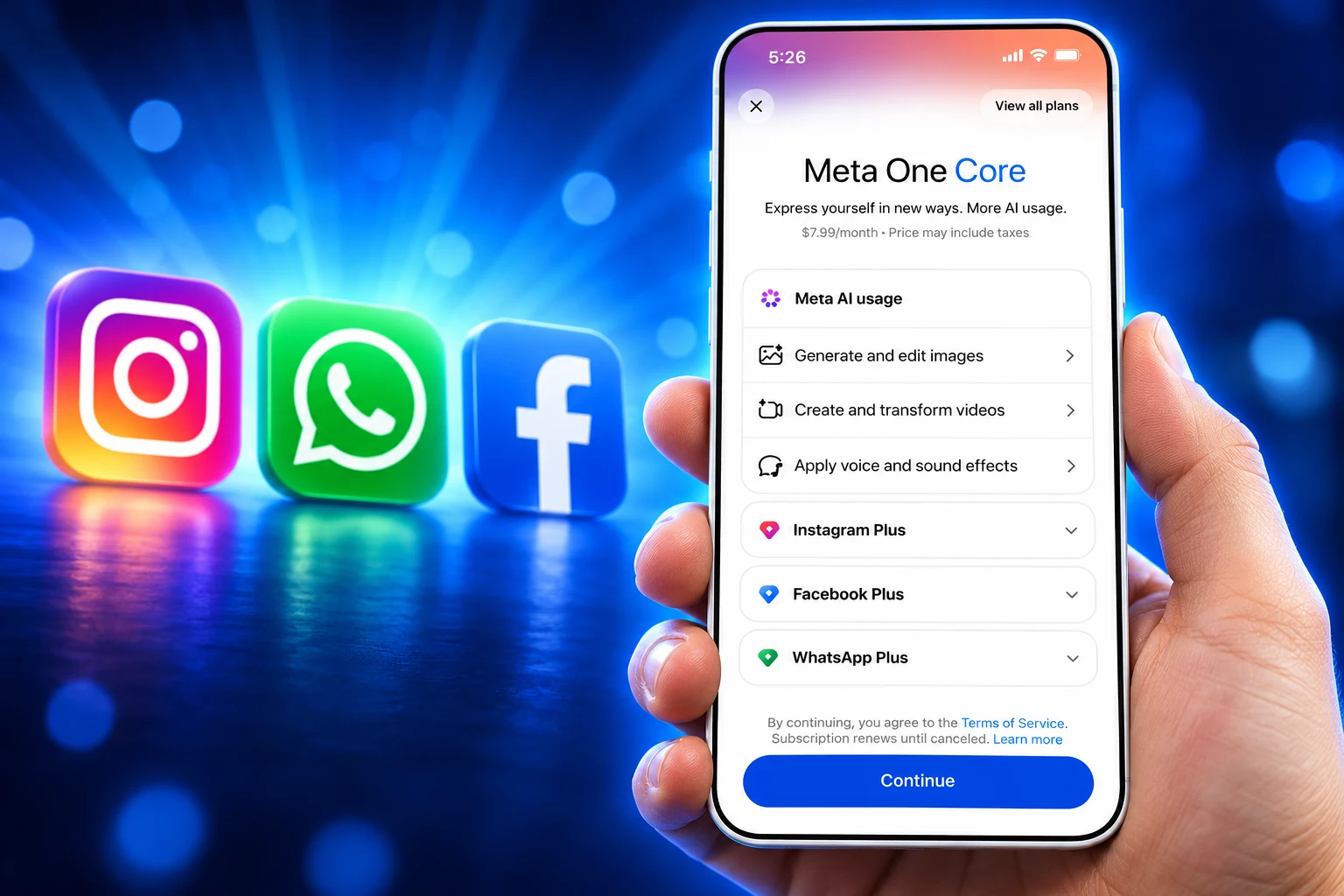
Meta priced its Meta One subscription on September 15, 2026, at $7.99 a month for Core and $19.99 for Premium. The bundle puts Instagram Plus, Facebook Plus, and WhatsApp Plus on one bill and sells extra image and video generation, while the company says the core apps and everyday Meta AI stay free.
That split is the product. Heavy Muse generation, Restyle, and a business agent get a meter. The feed, the chats, and the ads do not move with it.
We're introducing Meta One, a new subscription service on Facebook, Instagram, WhatsApp, and Meta AI that gives you access to more AI, expression features, and tools to help creators and businesses.https://t.co/Gog56h0wws
— Meta Newsroom (@MetaNewsroom) September 15, 2026
A $7.99 Bundle Beats Buying Plus Three Times
Earlier this year Meta sold the extras app by app. Instagram Plus is $3.99 a month, Facebook Plus is $3.99, and WhatsApp Plus is $2.99. Bought apart they come to $10.97. Core is $7.99 and includes all three, plus more Restyle, voice effects, and Meta AI media. The gap is $2.98 if you wanted every Plus perk anyway.
Premium does not add a fourth app. It raises the same AI ceiling. Meta would not publish the numeric caps, saying they can vary by country, surface, and system conditions. The help pages describe only a larger monthly AI usage allowance on Premium than on Core.
THE CONSUMER PRICE CARD
| Plan | Monthly price | What you get |
|---|---|---|
| WhatsApp Plus | $2.99 | Themes, extra pinned chats, stickers |
| Instagram Plus | $3.99 | Fonts, longer Stories, viewer tools |
| Facebook Plus | $3.99 | App icons, super hearts, Reels extras |
| Three Plus bought apart | $10.97 | All three apps, no extra AI pool |
| Meta One Core | $7.99 | All three Plus plans plus more AI |
| Meta One Premium | $19.99 | Core, with the highest AI headroom |
Single-app plans remain on sale. A WhatsApp-only buyer can still pay $2.99 and skip the Instagram fonts. Core is the nudge to stop doing that math.
The Phased Rollout Already Had Paying Users
Meta did not switch this on from zero. The newsroom said plans are rolling out with more than 50 features and 15 million subscriptions and trials to date. That count mixes paid seats and free trials, so it is not a clean paid base.
Meta averaged 3.60 billion daily active people across its apps earlier this year. Fifteen million trials on that scale is a thin slice. It is still a live billing system sitting on apps people already open.
THE LAUNCH IN FIGURES
- 15 million: Subscriptions and trials Meta said it had at launch, including the earlier Plus tests.
- 50+ features: The opening set across Instagram, Facebook, WhatsApp, and Meta AI.
- $7.99 Core: The individual bundle that undercuts three separate Plus plans.
- 3.60 billion: Daily active people Meta averaged across its family of apps earlier this year.
Help pages still warn that some accounts will not see Meta One yet. The newsroom said the plans are available globally, with benefits, prices, and availability varying by region, app, and account. Both can be true at once: the catalog is public, the switch is not on every profile.
FROM PLUS APPS TO META ONE
- May 2026: Instagram Plus, Facebook Plus, and WhatsApp Plus go on sale as single-product plans, with Meta already testing broader Meta One tiers.
- Early testing, 2026: Bundled Core and Premium plans run in limited markets. Meta said more than half of those subscribers used both AI and expression features.
- September 15, 2026: Meta One is announced as the home for consumer bundles and creator-business plans, with Edits and AI glasses named as later add-ons.
Naomi Gleit, Meta’s head of product, said of the Plus plans when they launched that they offer richer ways to express and connect, with more fun features to be added. Meta One is that next layer, sold as one catalog instead of three store listings and a side AI meter.
Muse Video Is the Compute Meta Wants to Bill
Core and Premium exist because image and video generation is expensive to run at feed scale. Meta said the bundles combine Plus perks with more use of compute-heavy AI, including creating and editing images and generating videos with Muse image and video models, plus in-app tools such as Restyle on Instagram.
The core experience across our apps and Meta AI has always been free, and that’s not changing. Subscriptions unlock more specialized capabilities and expanded AI usage that go beyond what a free experience built for billions can offer.
Meta, Introducing Meta One, September 15, 2026
In early testing, Restyle and voice effects on Instagram were among the top reasons people subscribed. Everyday Meta AI chat stays free. The paid increment is more generations and more edits, not a new login.
That is also where the first objection lands. People who already pay for a chatbot want to know whether a separate Muse assistant plan is inside Core. Meta’s own copy answers a narrower question: Meta AI stays free for everyday use, and Core and Premium buy more creative room. It does not publish how many Muse clips sit in the $7.99 bucket, or whether a standalone Muse seat is coming.
Premium at $19.99 sits next to the usual $20 cluster for ChatGPT Plus and the $19.99 Google AI Pro list price. ChatGPT Go is listed at $8, a dollar from Core. Those plans sell a general assistant. Meta One sells more of the tools already inside Instagram, WhatsApp, Facebook, and Meta AI. It is a worse deal if you wanted GPT-class chat. It is a better one if you already Restyle Stories and were about to buy three Plus apps.
WHAT WE KNOW
- The meter: Core and Premium are sold as extra monthly AI use on Muse generation, Restyle, and related tools, not as a replacement for free Meta AI chat.
- The test result: More than half of early bundle subscribers used both AI and expression features, with Restyle and voice effects among the top reasons.
- The cap: Meta declined to give numeric usage limits, and the help center describes only “more” and “expanded” allowances.
WHAT IS UNCONFIRMED
- Clip counts: How many Muse images or videos a Core or Premium subscriber can make each month.
- Muse as a seat: Whether a separate Muse assistant subscription will be folded into Meta One or sold on its own.
- Verified move: When existing Meta Verified subscribers are shifted across, and on which plan.
Until those numbers land, Premium is a $12 step up from Core for an unpublished ceiling. That is a hard sell next to a chatbot that at least names its model.
Verified Prices Reappear as Essential Through Max
The consumer story stops at $19.99. The catalog does not. Creator and business plans start at $14.99 for Essential, $49.99 for Advanced, $149 for Expert, and $499 for Max. Those rungs match Meta Verified’s Standard, Plus, Premium, and Max list, which still shows $14.99, $49.99, $149.99, and $499.99 per profile in the app, with Standard at $11.99 on the web.
Meta’s Verified site now says those features are in Meta One, and that the new service builds on Meta Verified. Essential carries the verified badge, a verified WhatsApp Business channel, impersonation protection after a successful check, and more access to Meta Business Agent on WhatsApp for round-the-clock replies. The blue tick is no longer a stand-alone product in the pitch. It is the floor of a SaaS ladder.
THE VERIFIED PRICE ECHO
| Rung | Meta One start price | Meta Verified list, per profile |
|---|---|---|
| Essential / Standard | $14.99 | $14.99 in-app, $11.99 on the web |
| Advanced / Plus | $49.99 | $49.99 |
| Expert / Premium | $149 | $149.99 |
| Max / Max | $499 | $499.99 |
The cent gaps are list-versus-start, not a discount. Verified was already billed per profile, so a creator who wants the tools on both Instagram and Facebook pays twice unless they take a linked bundle. Meta One inherits that. The help pages say benefits apply to the subscribed profile. A shop that lives on both apps is looking at two Advanced bills, $49.99 each, on top of ads.
What $49.99 Buys a Creator on Instagram
Advanced is where Meta stops selling fonts and starts selling work the company used to leave to Hootsuite-class tools, or not offer at all. The help center is more specific here than the newsroom.
WHAT ADVANCED UNLOCKS
- Scheduling: Stories up to 30 days ahead, posts and Reels up to a year, with suggested times and bulk upload on instagram.com.
- Clickable links: Up to 4 Instagram posts a month, 4 Instagram Reels, and 8 Facebook Reels.
- Team access: Up to 4 people on an Instagram account without sharing the password, plus 6 linked devices and 3 WhatsApp Business channels.
- Broadcast credits: 500 WhatsApp Business broadcast credits, and more Business Agent replies than Essential.
- Insights: Exportable Instagram data, a longer look-back, competitive comparisons, and Facebook insights on people who see you but do not follow.
- Support: One human-agent chat a month, plus original-content credit twice a month on Facebook and Instagram.
Expert, from $149, raises those caps: 8 teammates, 1,250 broadcast credits, 8 Instagram post links, 8 Instagram Reels and 20 Facebook Reels, and 5 human chats a month, with a callback that counts against the limit. Max, from $499, goes to 30 teammates, 5,000 credits, 12 Instagram post links, 12 Instagram Reels and unlimited Facebook Reels, 10 WhatsApp channels, 10 linked devices, and up to 50 protected business accounts. Max also includes a content-strategy call with an adviser every 6 months and human chat as often as needed.
Those numbers are the second-order product. A $7.99 Core buyer gets longer Stories and more Restyle. A $499 Max buyer gets a support desk, a staff roster, and a WhatsApp agent that is supposed to answer at 2 a.m. Meta said it will keep adding agent skills for marketing, operations, content, and optimisation. The free apps remain the storefront. The paid plans are how Meta charges for running them like software.
Ads Stay on Every Paid Tier
Nothing in the published Meta One lists takes ads out of Facebook, Instagram, or WhatsApp. The perks are extra AI use, Plus customisation, verification, scheduling, links, and agent replies. In some markets Meta already sells a separate no-ads subscription, with its own prices on web and in the app stores. That product is not Meta One.
Paying $19.99 therefore does not buy a clean feed. It buys more generations on a feed that still carries ads. The same is true at $499. A Max subscriber still funds the ad machine that reaches the 3.60 billion people who never pay.
That split is why Core can be cheap. Meta does not have to replace ad revenue on a Core account. It only has to cover extra Muse renders and keep the Plus perks from being bought three times at $10.97. The expensive work, Business Agent replies and long video generations, sits on the plans that start at $14.99 and climb.
Paid benefits are also not meant for government or political entities, including politicians. The help center says a breach can mean the subscription is revoked. The meter is for creators and shops, not campaigns.
Edits Plus and the Glasses Come Next
Meta already named the next two add-ons. Edits Plus is due as a Meta One product with more cloud storage so projects sync across devices, plus extra use of an upcoming Edits assistant that reads Instagram insights and suggests ideas. AI glasses are on the same expansion list, with no date and no price.
Each add-on gives the meter somewhere new to run. Storage, assistant queries, and on-glass generation are all usage. Once they live inside Meta One, Meta can raise a tier instead of shipping them free to 3.60 billion people. The company said more than half of early bundle subscribers already touched both AI and expression. Restyle taught it that people will pay for a look. Edits Plus tests whether they will pay for an editor that reads their own stats.
Until the numeric Muse caps are public, Core is a $2.98 discount on three Plus apps with an unpublished AI bonus, and Premium is a $20-shaped plan that still shows ads. The ladder that matters for Meta’s take is Essential through Max, where Verified’s old prices now buy an agent, a schedule, and a support queue on the apps the customers already use.

Windows 11 Search Can Now Run the PC Itself

France Pauses Stun Grenades After a Familiar Kind of Injury

Amazon Buys the Emmys as a Global Storefront

Atlassian’s 9.3 File-Read Bug Repeats a 2021 Exploited Flaw

Winklevoss Files a Zcash ETF Around Its Own Stack

Tozorakimab Opens a COPD Lane Other Biologics Shut

Astro City Still Pays Off a 1995 Superhero Wager

Acetaminophen Liver Injuries Soared After a Narrow FDA Cap

Lionel Richie Faces Heart Tests After the Muny Show

Sony’s 10 Percent Disc Cut Leaves New Games Digital
-
 NEWS2 months ago
Tozorakimab Opens a COPD Lane Other Biologics Shut
-
 ENTERTAINMENT2 months ago
Astro City Still Pays Off a 1995 Superhero Wager
-
 NEWS2 months ago
Acetaminophen Liver Injuries Soared After a Narrow FDA Cap
-
 ENTERTAINMENT2 months ago
Lionel Richie Faces Heart Tests After the Muny Show
-
 GAMING1 month ago
Sony’s 10 Percent Disc Cut Leaves New Games Digital
-

 BUSINESS2 months ago
Calvin Klein’s Record Jung Kook Collab Could Not Lift Sales
-

 BUSINESS2 months ago
Trump’s Embargo Threat Spends the Leverage It Needs
-

 NEWS1 month ago
Texas Puts a Human on Every Consequential AI Decision