
NEWS
France Pauses Stun Grenades After a Familiar Kind of Injury
France froze stun grenades at school protests after a 15-year-old lost a hand in Lens, repeating a 2020 retreat while the education file stays unfunded.

France paused stun grenades at high-school protests on Wednesday after a 15-year-old in Lens lost his left hand. Interior Minister Laurent Nuñez limited the freeze to the lycée movement until investigators finish with Monday’s blast.
Tear gas, batons and water cannon stay in the kit. The crumbling schools that started more than two weeks of unrest still have no spare cash.
Stun Grenades Stay Legal Outside School Protests
Nuñez told the country on Wednesday that he had already asked, on Tuesday, for the round to stop being used against the high-school movement. He said there was a “strong possibility” a stun grenade had taken the boy’s hand, and that he was freezing the munition “until light has been shed on what happened in this case.”
The order is narrower than the headline. A note from the director general of the national police, described as a precaution, covers an Alsetex ASSD stun grenade fired from a launcher, and only in lycée protests, for as long as the Lens file remains open. Other crowd tools were left untouched. Nuñez also rejected claims of police brutality as “excessive,” saying officers do not step in when a protest stays peaceful.
Anne Savinel-Barras, president of Amnesty International France, called the freeze a first step and said the devices should be permanently banned from all protests, not parked for one movement.
These dangerous devices, which have a long history of causing serious injuries, must be permanently banned from the policing of all protests.
Anne Savinel-Barras, President, Amnesty International France
That gap between a lycée-only pause and a ban is why the marches did not fold on Wednesday. The freeze can be lifted the day the Lens inquiry writes its note, and it never applied to universities, labour rallies or anything else the police still treat as a crowd problem.
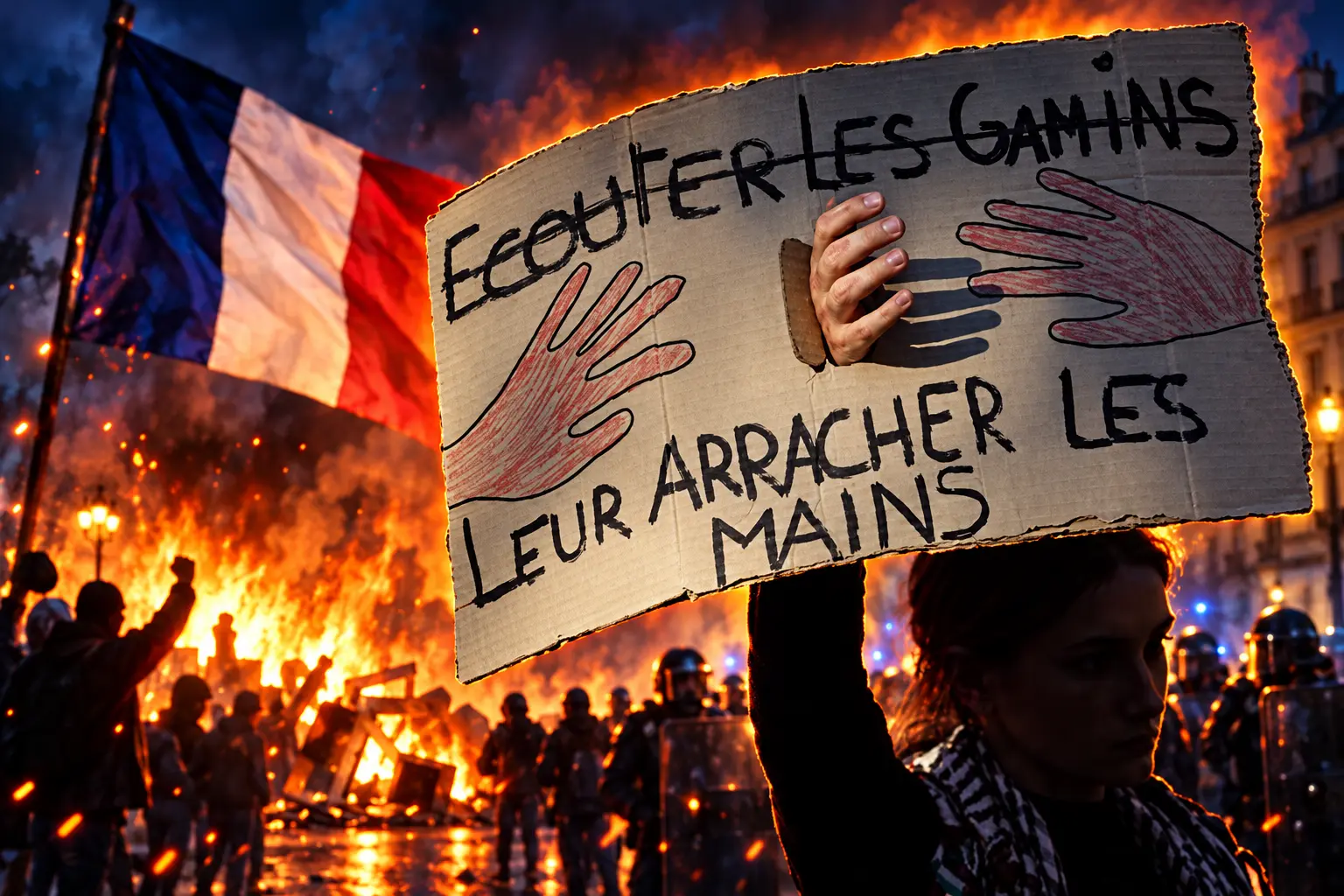
A 15-Year-Old Lost His Left Hand in Lens
The blast was around 11 a.m. on Monday, October 5, outside lycée professionnel Auguste Béhal in Lens, in the Pas-de-Calais. The boy, a 15-year-old in seconde, had his left hand torn off and later amputated. François-Xavier Lauch, the prefect, said police had faced about 200 to 250 pupils throwing stones and fireworks. Étienne Thieffry, the Béthune prosecutor, said on Monday he could not yet say whether the boy had picked a grenade up or whether it had landed on him.
A short amateur video authenticated on Wednesday shows the grenade on the ground at the feet of two teenagers, with a third leaning toward it, then leaving the frame before the bang. The clip does not show a pickup. It does cut against witnesses who said the round hit his hand. The boy’s mother denied that he tried to grab it.
His life has been stolen. He’s a 15-year-old kid, how can children be treated like that?
The injured boy’s mother, after the Lens amputation
WHAT WE KNOW AND WHAT IS STILL OPEN
- The injury: The 15-year-old lost his left hand outside Auguste Béhal on Monday and was amputated.
- The munition: Nuñez cited a strong chance it was a stun grenade; the police note names an Alsetex ASSD round fired from a launcher.
- The officer: A CRS with the grenade launcher was heard as a witness and was authorised to fire; investigators still have to test whether that shot was ordered, proportionate, and the only stun round that day.
- The video: Footage shows a grounded grenade and a teenager leaning in, then a detonation, without proving he picked the device up.
The police inspectorate, the IGPN, now has 18 investigations from the school unrest. One already produced a charge: a 14-year-old at lycée Château d’Epluches in Saint-Ouen-l’Aumône was hit in the face by a tear-gas grenade launcher, with a broken jaw and smashed teeth, and the officer was placed under judicial control. Nuñez also listed a young protester who lost several teeth and another who lost the use of an eye. Speaking to the National Assembly on Wednesday, he gave a running toll since September 28 of 6,629 arrests, 761 police and gendarmes wounded, 215 pupils hurt and 89 education staff hurt.
France Already Retired One Crowd Grenade After Amputations
The Lens pause sits on a well-worn path. In 2014 a gendarme’s OF F1 grenade killed Rémi Fraisse, 21, at the Sivens dam site, and that family of explosive “offensive” rounds was pulled. During the Yellow Vest unrest the GLI-F4, a hybrid tear-gas grenade with a TNT bursting charge, was blamed for dozens of wounds, including five disabling hand injuries. Interior Minister Christophe Castaner withdrew it on January 26, 2020, after protesters who picked the canisters up were gravely hurt.
That was the same mechanism now disputed in Lens. The replacement line, including Alsetex stun and combined-effect grenades fired from launchers, was sold as cleaner. Hand-throwing of the GM2L was later restricted. The political product did not change: a munition stays in service until a mutilation forces a pause, and the pause is written as temporary.
CROWD GRENADES FRANCE HAS ALREADY HAD TO PULL
| Year | Round | Trigger | What the state did |
|---|---|---|---|
| 2014 | OF F1 | Rémi Fraisse killed at Sivens | Explosive “offensive” grenades withdrawn |
| 2020 | GLI-F4 | Yellow Vest hand injuries, including pickups | Withdrawn on January 26, 2020 |
| 2026 | Alsetex ASSD stun grenade | 15-year-old loses left hand in Lens | Paused for lycée protests only, pending inquiry |
Nuñez still refuses a change of crowd-control doctrine. The Lens freeze, in that light, is a file-management step. It takes one round out of one kind of protest and leaves the rest of the toolkit, and the rest of the calendar, intact.
What Lecornu Promised by the End of October
Prime Minister Sébastien Lecornu spoke to the nation on Wednesday evening and tried to pull the story back from the police line to the school file. “The anger among young people didn’t come out of nowhere,” he said. He called the demands legitimate, then described the unrest as the most violent student demonstrations in decades.
He also warned against a familiar French habit. “In the past, too many promises were not kept, quite simply because they were untenable,” Lecornu said. “What I want are concrete, quick and fully funded answers.” First decisions, he said, would come at the end of October. A public platform had already taken in more than 40,000 notes from pupils.
THE FIVE SCHOOL WORKSTREAMS
- Absent teachers: Faster substitutes for long absences and unfilled posts, above all in exam classes, plus catch-up on short holidays.
- Buildings: Repairs and heat-proofing, with regions asked for work that can start before summer 2027.
- The school day: A look at overloaded timetables and how the day is carved up.
- Parcoursup: A clearer university-admissions platform for the 2027 campaign.
- Pupil voice: A cleaner channel for lycée students, including those far from existing councils.
Student leaders left talks at the education ministry on Wednesday saying they had heard no immediate answer. At lycée Lamartine in central Paris, pupils sang the Marseillaise and blocked the gates anyway. Gabriel Fillieule, who moved from a public school to a private one, said they were out because of crumbling walls, missing teachers and unequal conditions. “We saw there were lots of crumbling walls, a shortage of teachers in public schools, absent teachers,” he said.
Reading Scores Fell 43 Points in a Decade
The OECD’s PISA 2025 results, released on September 8, are the hard floor under those complaints. French 15-year-olds scored 456 points in reading against an OECD average of 461, and 458 in maths against 463. Science, at 483, sat on the OECD line of 482. Reading fell 18 points from 2022 and maths 16, and the 2025 crop is among the weakest France has ever posted on the test. Reading is 43 points below the 2015 score, the slide protesters cite when they talk about a wasted decade.
Only 67 percent of French 15-year-olds reached Level 2 in reading, the OECD’s basic mark, so 33 percent did not. In maths, 64 percent cleared Level 2 and 36 percent did not. Against 2015, the share of low performers rose 11 percentage points in reading and 12 in maths. Socio-economic status explained 13.5 percent of the science spread in France, against 11.6 percent across the OECD, with a 100-point gap between the top and bottom quarters.
FRANCE ON PISA, 2022 TO 2025
| Subject | France 2025 | OECD 2025 | Change since 2022 |
|---|---|---|---|
| Reading | 456 | 461 | -18 |
| Mathematics | 458 | 463 | -16 |
| Science | 483 | 482 | -4 |
The education ministry PISA 2025 note put French scores near the OECD mean and still falling in reading and maths, with large social gaps. About 6,501 French pupils sat the test, among 91 countries and economies. That is the backdrop Lecornu now has to answer with “fully funded” measures a few months before a presidential vote.
The Budget Adds €1.2 Billion Against a €10 Billion Ask
Education unions had asked for about €10 billion more. Lecornu pointed instead to an extra €1.2 billion in 2027, taking the national education budget to €64 billion, and presented that as one of the few rising ministry lines. He ruled out a major new spending wave. The state is trying to hold down a heavy public debt, and the government has little room for the teacher shortages, ageing blocks and rich-poor school gaps that pupils keep naming.
An Elabe poll found 72 percent of French adults think the students’ demands are legitimate, and 55 percent think the protests should stop. That split is the political box. Marine Le Pen, the far-right presidential front-runner in current polls, said people who smash schools should pay for the repairs, not taxpayers. The government has a bill moving through parliament to build a similar “wreckers pay” system, due at the Senate later in October.
THE MONEY ON THE TABLE
- Union ask: About €10 billion more for public education.
- Government add: €1.2 billion in 2027, for a €64 billion education budget.
- Repair bill: €20 million to €30 million ($22 million to $34 million) to fix fire and vandalism damage already done.
- Public mood: 72 percent call the demands legitimate; 55 percent want the protests to end, per Elabe.
Education Minister Édouard Geffray told parliament that 24 high schools were so damaged by fire or vandalism that they will stay shut for weeks, leaving some 30,000 pupils without face-to-face teaching. France has about 3,700 lycées. Even a full rebuild fund at the top of Geffray’s range would not touch the PISA drop or the missing teachers.
Proposals Due in Late October as Marches Go On
The movement began in mid-September at a lycée in Créteil, in the Val-de-Marne, and spread. Parents, university students and unions joined. On Tuesday, police counted 256,000 people in the streets and organisers 450,000. About 80 campuses, including Sciences Po in Paris, were blockaded on Wednesday in mostly calm actions, though police used tear gas on a street barricaded with bins outside the school. Unions in the education sector, and lycée and student groups, called strikes and an “Act IV” for Thursday, October 8. Lecornu had already said regular classes would stop on Thursday and Friday so heads could hold sessions with pupils.
HOW THE SCHOOL PROTESTS SPREAD
- Mid-September 2026: Blockades start at a lycée in Créteil and move across academies.
- October 5, 2026: A 15-year-old loses his left hand outside Auguste Béhal in Lens.
- October 6, 2026: A national day of marches draws 256,000 people by the police count and 450,000 by organisers.
- October 7, 2026: Nuñez pauses stun grenades for the lycée movement; Lecornu promises first school decisions at the end of October.
- October 8, 2026: Unions and pupil groups call further marches; classes are set aside for talks inside schools.
Geffray’s 24 wrecked lycées will still be closed when those talks end. The Lens CRS file will still be open. The Alsetex round will still be legal everywhere except the one movement named in the police note. Lecornu has until the last days of October to put numbers on substitute teachers, roofs and timetables, after saying out loud that earlier promises failed because they could not be paid for.

Windows 11 Search Can Now Run the PC Itself

France Pauses Stun Grenades After a Familiar Kind of Injury

Amazon Buys the Emmys as a Global Storefront

Atlassian’s 9.3 File-Read Bug Repeats a 2021 Exploited Flaw

Winklevoss Files a Zcash ETF Around Its Own Stack

Tozorakimab Opens a COPD Lane Other Biologics Shut

Astro City Still Pays Off a 1995 Superhero Wager

Acetaminophen Liver Injuries Soared After a Narrow FDA Cap

Calvin Klein’s Record Jung Kook Collab Could Not Lift Sales

Sony’s 10 Percent Disc Cut Leaves New Games Digital
-
 NEWS1 month ago
Tozorakimab Opens a COPD Lane Other Biologics Shut
-
 ENTERTAINMENT1 month ago
Astro City Still Pays Off a 1995 Superhero Wager
-
 NEWS1 month ago
Acetaminophen Liver Injuries Soared After a Narrow FDA Cap
-
 BUSINESS1 month ago
Calvin Klein’s Record Jung Kook Collab Could Not Lift Sales
-
 GAMING1 month ago
Sony’s 10 Percent Disc Cut Leaves New Games Digital
-

 BUSINESS1 month ago
Trump’s Embargo Threat Spends the Leverage It Needs
-

 ENTERTAINMENT1 month ago
Lionel Richie Faces Heart Tests After the Muny Show
-

 NEWS4 weeks ago
Texas Puts a Human on Every Consequential AI Decision