
ENTERTAINMENT
Astro City Still Pays Off a 1995 Superhero Wager
Kurt Busiek’s Astro City was a 1995 bet that sincere superheroes could last. Thirty-one years later the Metrobooks are still in print.

In August 1995, Kurt Busiek, Brent Anderson and Alex Ross put Astro City on Image Comics racks as a bet that sincere superhero comics still had gas. The first issue followed a Superman stand-in through a day sliced into half-seconds. When the work stopped, he dreamed of flying with no one to save.
Thirty-one years later the monthly book is quiet, the screen versions never arrived, and the city is still in print. That is the wager paying out.
They Bet Against the Dark Age in 1995
By 1995 the direct market was choking on unsold foil covers and books ordered for the speculator pile. Marvel had bought its own distributor, shops were closing, and Image had made its name on pouches, guns and double-page splashes. Watchmen and The Dark Knight Returns had taught a decade of writers that heroes should brood. Busiek wanted the other job.
He and Ross had already tried the idea inside someone else’s toys. Their 1994 Marvel miniseries Marvels followed news photographer Phil Sheldon from the Human Torch’s debut through Galactus, and it made both men famous overnight. In Busiek’s Marvels origin interview he said neither man was a name when they started, and that Astro City was the ongoing book people finally saw him write after that four-issue burst.
A whole new city meant no continuity cops and no trademark lawyers. Ross was already tied up painting Kingdom Come with Mark Waid for DC, so monthly interiors were out. Anderson, the X-Men: God Loves, Man Kills veteran with a quieter, classical line, took the inside pages. Ross kept the painted covers and the character designs. Image #1 arrived in August 1995 at $2.25 for 36 pages.
We’ve been taking apart the superhero for ten years or more; it’s time to put it back together and wind it up, time to take it out on the road and floor it, see what it’ll do.
Kurt Busiek, foreword to Life in the Big City, 1997
He told Marv Wolfman the same idea in plainer words: put superheroes back as figures of wonder without losing a sense of humanity. Jim Lee needed a writer-first imprint to sit beside WildStorm’s splash pages, and he used Astro City to open Homage Comics. In the Homage Comics launch announcement dated March 2, 1996, Lee said it was a matter of finding the right property to kick the line off, and that they had done that with Astro City.
Volume 2 #1 shipped in August 1996 under Homage, with Will Blyberg inking and Alex Sinclair on color. WildStorm later sold to DC, so the same creator-owned city moved through WildStorm and Vertigo without Busiek selling the rights. The book kept changing letterheads. The bet did not.
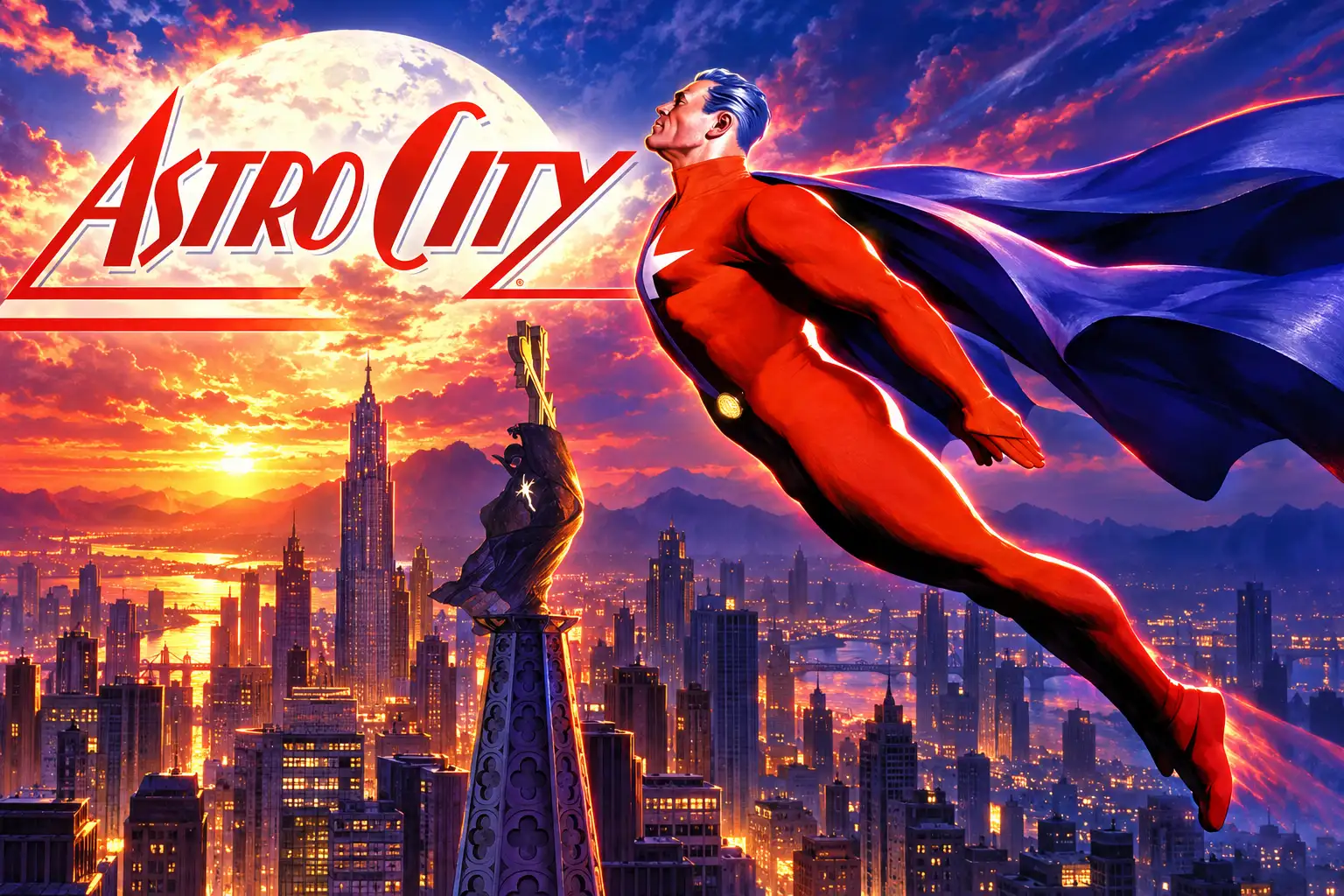
Samaritan Only Flies in His Sleep
Issue 1 is called “In Dreams,” and it is still the cleanest proof of what they were selling. Samaritan, a time traveler who arrived in this era in 1985 and went public in 1986, spends his waking hours on a clock. He times rescues in half-seconds. He sits through a civic award he does not want. He gets home late, falls into bed, and finally flies the way a person flies in a dream, with no fire to put out and no crowd to please.
That last image is the whole thesis. Marvel and DC can always stage another collapse of a bridge. They almost never stop a flagship Superman long enough to admit the work has eaten the joy. Busiek has said the Samaritan story sat in a drawer after Scott McCloud dared him to try a 24-Hour Comic; he never made the 24-hour version, but he kept the feeling of old flying dreams and built a hero around it.
Honor Guard stands in for the Justice League and the Avengers. Winged Victory rhymes with Wonder Woman. The Confessor rhymes with Batman. The First Family rhymes with the Fantastic Four. Assemblyman is the iron suit. Cleopatra swings a hammer. Jack-in-the-Box, who debuts in issue 3 from a rejected Spider-Man pitch, does not rhyme as cleanly: a clown hero with gag gadgets and a mean joke, strange enough to feel native to this city rather than borrowed from Queens.
Busiek later drew a hard line between this book and the Marvel titles he was writing at the same time. Those books, he told interviewer Jamie Coville, run on “What happens next?” Astro City runs on “So, how do you feel about that?” The plots are familiar on purpose. The angle of view is the product.
Eisner Voters Said Yes Twice in Two Years
The industry did not treat the first year as a cult oddity. Comic-Con’s own 1996 Eisner Awards for 1995 gave the new series two of the night’s major prizes, then came back a year later and did it again.
| Awards night | Prize | Work named |
|---|---|---|
| 1996 (for 1995) | Best New Series | Kurt Busiek’s Astro City |
| 1996 (for 1995) | Best Single Issue | #4, “Safeguards” |
| 1996 (for 1995) | Best Cover Artist | Alex Ross, Astro City |
| 1997 (for 1996) | Best Continuing Series | Kurt Busiek’s Astro City |
| 1997 (for 1996) | Best Single Issue | Vol. 2 #1, “Welcome to Astro City” |
Counting every volume, miniseries and special, more than 100 issues saw print. The longest unbroken stretch was the Vertigo run, Volume 3, which ran from August 2013 to August 2018 for 52 issues. Astro City Vol. 17: Aftermaths, dated May 14, 2019, collected #47-52 and billed itself as the close of the periodical series, including a sequel to “The Nearness of You,” the civilian-eye Crisis story a friend had dared Busiek to write.
Gaps never killed it. Homage to WildStorm to Vertigo to Image again is a tour most creator-owned superhero books do not survive. Anderson and Ross stayed. That is the unglamorous half of the bet: three people who did not get bored of the city they had made.
A Bank Job Nobody Would Believe
“Show ’Em All,” Astro City #10 from 1997, is the villain version of the same idea. Hiram Potterstone is a gifted engineer forced out of a research firm by a mandatory retirement rule. No one will hire him at his age, so he builds gadgets from discarded appliances, takes the name Junkman, and works out of a junkyard. He has already lost to Jack-in-the-Box more than once. This time he plans the job properly.
He robs a bank for millions, slips the heroes, and lands on a tropical island with the rest of his life paid for. He cannot stand being invisible. He overhears strangers gushing about superheroes, lets details of the perfect crime slip, and nobody believes a feeble old man could have beaten Honor Guard. They laugh. So he goes home and starts committing crimes in public, loud enough that the city has to notice. He beats most of the heroes who answer. He finally loses to Jack-in-the-Box, sits in court, and smiles when the prosecutor gives him full credit as a mastermind.
On a plot card it is a bank robber who gets caught. The heat is in the need to be seen. Busiek was writing Avengers with George Pérez in those same years, including the time-tangle of Avengers Forever, so the quiet register was a choice. He could do the cosmic engine. He used this book to watch a retired engineer pick a fight with oblivion.
The same habit fills the rest of the map. Steeljack tries to go straight in Kiefer Square. The Confessor keeps his history in shadow while a new sidekick tries to read him. Silver Agent’s tragedy is seeded years before it lands. Beautie is a walking doll who is also a person. Infidel, Samaritan’s opposite number, is a medieval slave turned immortal tyrant whose future empire the hero accidentally erased. None of that requires you to hate superheroes. It requires you to stand next to them.
Hollywood Optioned the City and Never Filmed It
FremantleMedia North America, announcing a live-action push in March 2018, called Astro City the last fully fleshed-out English-language superhero universe still unexploited for the screen, with more than 2,000 original characters. Busiek was set to co-write the pilot with Rick Alexander. Deadline noted a fact the Big Two cannot match: even while DC was publishing the comics, Busiek owned the rights and could shop the screen himself.
That was not the first swing.
THE SCREEN OPTIONS
- 2003: Producer Ben Barenholtz, writer Jonathan Alpers and Busiek form PanamaLeo LLC and buy the film rights, with Busiek attached to creative decisions.
- July 2010: Working Title’s Tim Bevan and Eric Fellner option a live-action feature. The deal is worth seven figures if the film is made. Busiek gets first shot at the script. Barenholtz and Alpers stay on as executive producers.
- May 2013: Busiek says the Working Title option has lapsed and that he is talking to someone else.
- March 2018: FremantleMedia North America, then behind American Gods, takes TV rights. Busiek and Rick Alexander write the pilot. Gregory Noveck executive produces. No series results.
A comics podcast spent this week doing a Wizard-style casting call for a live-action Astro City film, which is the same parlor game the industry has now declined three times. Anthology structure, a civilian point of view, and a lead whose big scene is a dream of unburdened flight are a hard pitch in a market that wants origin stories, shared-universe glue and a season-ending portal. The book that was supposed to prove sincerity still sells is also the book that never became IP in the modern sense.
Pick up issue 1 expecting a shock deconstruction and you get a story about loneliness, about a man whose schedule has eaten the one pleasure his power should guarantee. That mismatch is why the movie keeps getting recast in comments and never shot.
Six Metrobooks Keep the Wager in Print
Image took the series back in 2022. The same week it published the Astro City: That Was Then… special, it launched the Metrobooks, fat trades meant to put the whole run back on the shelf after years of spotty reprints.
THE SIX METROBOOKS
- Volume 1: March 30, 2022, 496 pages, $29.99, collecting the 1995 miniseries, the #½ issue, and Vol. 2 #1-12.
- Volume 2: August 31, 2022, continuing the Homage years including Local Heroes.
- Volume 3: February 15, 2023, collecting The Dark Age, the long crime-and-family saga that grew out of an unmade Marvels sequel.
- Volume 4: October 25, 2023, folding in the Samaritan, Beautie and Astra specials plus early Volume 3.
- Volume 5: March 20, 2024, the middle of the Vertigo run.
- Volume 6: January 22, 2025, collecting Vol. 3 #35-52, the end of the periodical line.
The 496-page first Metrobook is the practical on-ramp: “In Dreams,” the junkyard engineer still ahead, the reporter on his first day, the street criminal who learns a hero’s name and has to decide what the secret is worth. Image’s copy calls them the stories that changed how we think about superheroes. League of Comic Geeks lists Astro City: The Opus Edition, Book One, an oversized 1,168-page hardcover at $149.99, for December 8, 2026, with a Ross wraparound. As of late August that book had not landed.
There is no new monthly on the schedule. Busiek talked in 2022 about finishing other work and then starting a fresh Astro City series at Image. The listing that exists is the backlist, which is how a 1995 bet actually cashes: not as a forever shipping date, but as a city you can still walk into.
First-Time Readers Still Expect a Deconstruction
On Image’s own page the pitch has barely moved in 30 years. The city’s leading hero tries to be everywhere at once and berates himself for wasted seconds. A small-time hood learns a secret identity. A beat reporter gets advice on day one. A young woman tries to balance family and her own wants. The house line is that the slice-of-life stories feel like real people, and that this is where the power is.
That copy still describes the thing people find when they arrive now. The grimdark lesson of 1986 is in every streaming series. The reconstruction lesson of 1995 is in six paperbacks and a painted cover of a man in red who cannot spare a second to enjoy the air. The Opus hardcover, if it ships in December, will put the first nine years under one board. Until then the Metrobooks are the proof. The city is still open. The dream of flight is still in issue 1.
Frequently Asked Questions
Who Created Astro City, and Who Draws It?
Kurt Busiek writes it. Brent Anderson draws the interiors, with Will Blyberg inking much of the Homage period and Alex Sinclair coloring from the 1996 relaunch on. Alex Ross paints the covers and designs the characters with Busiek and Anderson; he did not draw the monthly interiors because he was already committed to Kingdom Come at DC when the series began.
Is Astro City a Marvel or DC Comic?
Neither owns it. The series is creator-owned. It began at Image, moved to Jim Lee’s Homage imprint, followed WildStorm to DC, spent its 52-issue Volume 3 at Vertigo, and returned to Image in 2022 for the That Was Then special and the Metrobooks. Busiek kept the screen rights even while DC was publishing the floppies.
What Was Homage Comics in the 1990s?
Homage was WildStorm’s writer-first line, launched to sit beside Image’s artist-driven splash books. Jim Lee announced it on March 2, 1996, with Astro City Volume 2 as the lead title, solicited separately from the rest of Image and distributed by Diamond. Leave It to Chance, another Homage book, won Best New Series at the 1997 Eisners the same night Astro City won Best Continuing Series.
What Is the Best Place to Start Reading Astro City?
Metrobook Volume 1 is the designed front door, collecting Vol. 1 #1-6, the #½ issue “The Nearness of You,” and Vol. 2 #1-12 in 496 pages for $29.99. The series is an anthology in a shared city, so later Metrobooks still make sense on their own, but Volume 1 is where Samaritan, Jack-in-the-Box and the Honor Guard first take shape.
Has Astro City Been Made Into a Movie or Show?
No film or series has been produced. PanamaLeo bought movie rights in 2003, Working Title optioned a feature in 2010 on a seven-figure if-made deal that later lapsed, and FremantleMedia North America announced a TV pilot in 2018 with Busiek co-writing. All three stalled, which is why the Metrobooks, not a streaming logo, are how the city reaches new readers.

Windows 11 Search Can Now Run the PC Itself

France Pauses Stun Grenades After a Familiar Kind of Injury

Amazon Buys the Emmys as a Global Storefront

Atlassian’s 9.3 File-Read Bug Repeats a 2021 Exploited Flaw

Winklevoss Files a Zcash ETF Around Its Own Stack

Tozorakimab Opens a COPD Lane Other Biologics Shut

Astro City Still Pays Off a 1995 Superhero Wager

Acetaminophen Liver Injuries Soared After a Narrow FDA Cap

Sony’s 10 Percent Disc Cut Leaves New Games Digital

Lionel Richie Faces Heart Tests After the Muny Show
-
 NEWS2 months ago
Tozorakimab Opens a COPD Lane Other Biologics Shut
-
 NEWS2 months ago
Acetaminophen Liver Injuries Soared After a Narrow FDA Cap
-
 ENTERTAINMENT2 months ago
Lionel Richie Faces Heart Tests After the Muny Show
-
 GAMING2 months ago
Sony’s 10 Percent Disc Cut Leaves New Games Digital
-

 BUSINESS2 months ago
Calvin Klein’s Record Jung Kook Collab Could Not Lift Sales
-

 NEWS2 months ago
Texas Puts a Human on Every Consequential AI Decision
-
 BUSINESS2 months ago
Trump’s Embargo Threat Spends the Leverage It Needs
-
 NEWS2 months ago
UCLA Bets Its Athletic Future on an Unpaid Lakers Executive