
BUSINESS
Nike Shares Fall 10.30% as Pace Cuts Follow Weak Sales
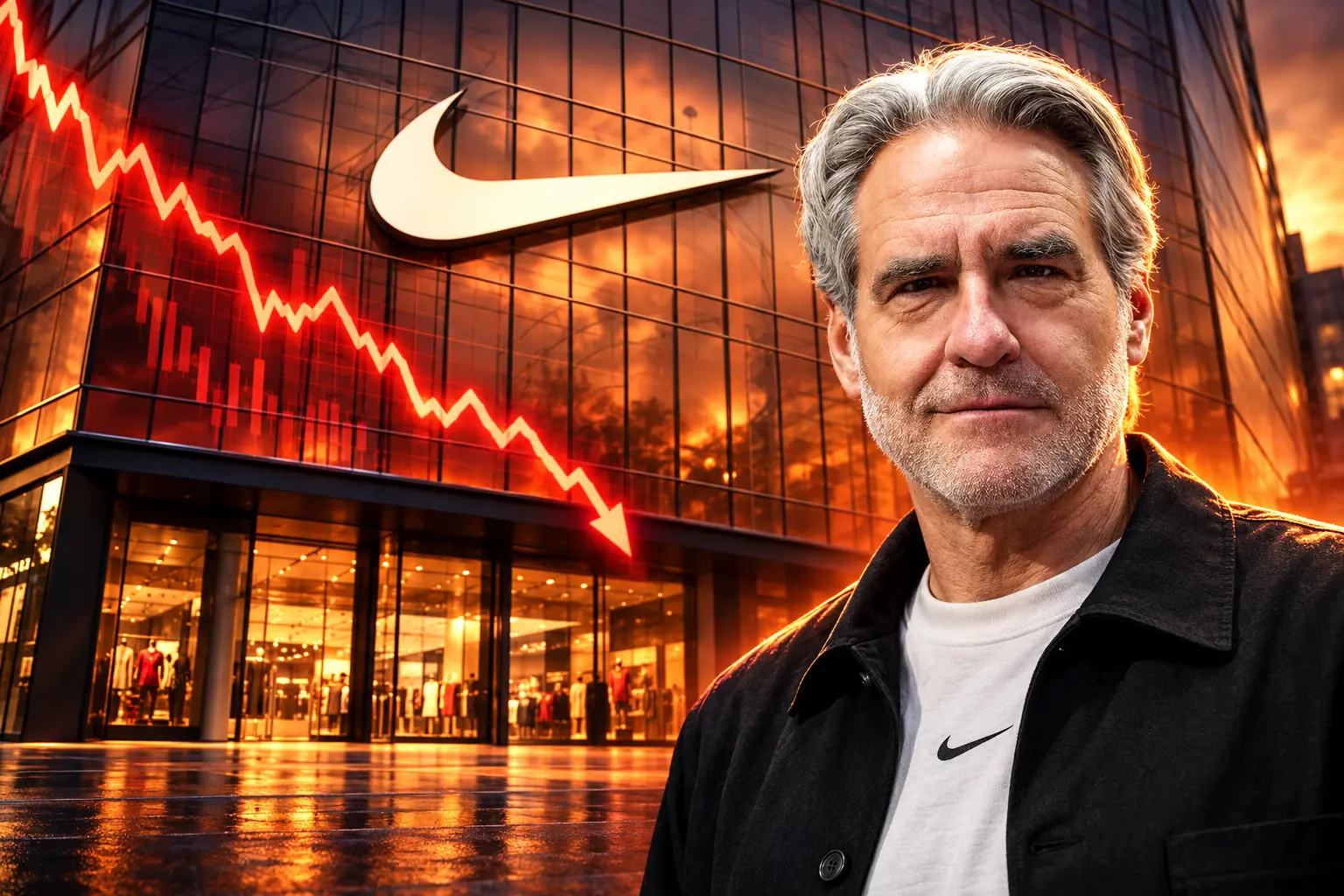
Nike shares fell 10.30% after $11.2 billion in Q1 sales and fiscal 2027 adjusted EPS guided to $1.15 to $1.35, with Pace job cuts starting in 2027.

Nike shares dropped 10.30% to $31.53 in October 2 premarket trade after weak first-quarter sales and a sharp cut to full-year earnings guidance. The print landed after the close on October 1, then deepened into Friday’s open.
President and CEO Elliott Hill also told staff the company would run a new operating plan called Pace, which he said will mean fewer roles across Nike, with decisions on those jobs beginning in calendar 2027.
Nike Shares Fell After a Sales Miss and a Soft Full-Year Guide
NIKE, Inc. posted first-quarter revenues of $11.2 billion for the period ended August 31, 2026, down 4% as reported and 5% in constant currency. LSEG’s consensus had been $11.32 billion of sales and 43 cents of earnings. Diluted earnings came in at $0.48, against 49 cents a year earlier.
Net income was $712 million, down 2% from $727 million. Gross margin rose 60 basis points to 42.8%, which the company tied to lower warehousing and logistics costs. Selling and administrative expense fell 3% to $3.9 billion.
Q1 FISCAL 2027 SNAPSHOT
- North America: Sales were $5.13 billion, up 2%, with wholesale in that market up 9%.
- Greater China: Sales were $1.18 billion, down 22% as reported and 26% in constant currency.
- Direct vs wholesale: NIKE Direct fell 8% to $4.1 billion; wholesale was $6.8 billion, down 1%.
- Converse: Sales were $263 million, down 28% in every territory.
EMEA sales fell 5% and Asia Pacific and Latin America were flat. NIKE Brand digital dropped 13% and Nike-owned stores dropped 5%. Demand-creation spending rose 5% to $1.3 billion on sports events, while operating overhead fell 6% to $2.7 billion on lower wages and other admin costs.
Inventories were $7.8 billion, down 3%. Cash and short-term investments were $8.4 billion. The company returned about $610 million through dividends in the quarter, up 3%. BahaWealth’s tape shows the stock down 8.08% over the past month, 20.46% over six months, and 52.86% over the past year.
Fiscal 2027 Earnings Guidance Falls Well Short of Last Year
The quarter’s small earnings beat did not hold the stock, because the full-year numbers did. Nike said fiscal 2027 revenue should decline at a high-single-digit rate. LSEG had been modeling a drop of about 2%. Adjusted diluted EPS is now $1.15 to $1.35, which excludes about $0.15 of Pace charges. The tax rate is expected in the mid-20% range.
New CFO Dave Denton, who joined on August 17 from a run as finance chief at Pfizer and Lowe’s, said first-quarter results were in line with internal plans. He also said operating profit should fall by a greater percentage than sales, as supply cuts and mix weigh on the year. The midpoint of the adjusted EPS range, $1.25, is about 40% below last year’s reported figure.
NIKE EARNINGS POWER BY FISCAL YEAR
| Fiscal year | Revenue | Diluted EPS |
|---|---|---|
| 2024 | $51.4 billion | $3.73 |
| 2025 | $46.3 billion | $2.16 |
| 2026 | $46.4 billion | $2.10 |
| 2027 guide | High-single-digit decline | $1.15 to $1.35 adjusted |
Nike’s own tables show diluted earnings of $2.10 in fiscal 2026 on $46.4 billion of sales, after $3.73 in fiscal 2024. Fiscal 2026 already included a $0.52 tariff-recovery benefit in the fourth quarter. The new guide is a lower earnings base, not a one-quarter dip.
Greater China Sales Drop 26% During the Digital Cleanup
Hill put Greater China on a short list of businesses that still need “deliberate actions.” Revenue there fell 26% in constant currency, after a 12% drop in the fourth quarter of fiscal 2026. Denton told analysts the full-year range assumes China sales get worse from here, because of steps already in motion.
In July, Greater China general manager Cathy Sparks said the online market had become too fragmented. From January 2027, most partner-run web shops stop selling Nike product. Sales move to official flagships on Tmall, JD.com and Douyin, plus Nike.com and the Nike app. Nike has more than 1,000 digital storefronts in China today, many tied to 16 store partners who still run the physical doors.
Those doors stay open. Hill said most partner stores in Greater China have not been refreshed in seven years. He pointed to the Shanghai House of Innovation, which he said has grown for 10 straight months after a sport-led reset. He also said the digital cleanup will take multiple seasons while partners work down inventory.
BNP Paribas senior analyst Laurent Vasilescu argued Nike does not have a channel problem in China so much as a product problem. Pulling partner sites can lift the price tag on the screen. It does not, by itself, make shoppers want the next shoe.
Dunks and Jordan Retros Are Being Pulled Back
NIKE Sportswear, which Hill said was just under half of the quarter’s sales, fell at a low double-digit rate. Part of that was planned. Nike cut Dunk revenue by nearly 50% in the quarter, a hit of about $200 million. Some higher-volume lifestyle shoes also sold through below plan, which has already marked future wholesale orders as partners clear extra stock.
Hill said the Air Force 1 is now a stable full-price franchise, and running-inspired models such as the P-6000 and V5 runner grew at a strong double-digit rate. Studio Fleece for women was, he said, the best-performing apparel collection in the company during back-to-school. The rest of the lifestyle rack still lacks energy, and traffic is thin.
Jordan Brand was 13% of the global business in the quarter, with sales down in the mid-teens. Hill said the company has been oversupplying iconic retro product and will cut both volume and launch frequency, as it did with the Air Jordan 1. North America will feel that first. The aim is a tighter scarcity model. The near-term cost is sales Nike used to book by flooding the market.
Despite that progress our Nike Performance business is not yet large enough to offset the pressure we’re seeing in Nike Sportswear, Jordan Brand and Greater China.
Elliott Hill, President and CEO, NIKE, Inc., on the October 1 earnings call
That sentence is the quarter. The growth plan is working in the sports Nike wants to own. It is not yet paying for the businesses that still print a large share of the bill.
Fewer Roles Begin in 2027 as Pace Targets $2.5 Billion
Pace is not a new product story. It is a four-year operating rewrite that folds in a cost plan first announced in March 2026. Hill told employees it is built around four priorities, and that “anything you may see in media reports around impacts is speculative” because the company does not yet know the number of roles or the sites.
THE FOUR PACE PILLARS
- Supply chain: A more variable cost base, with technology meant to speed service and cut waste.
- Three geographies: Americas (North America plus Latin America), APGC (Asia Pacific plus Greater China), and EMEA, with teams moving in fiscal 2028.
- Bengaluru campus: A new India site for Nike, Jordan Brand and Converse work, growing over several years.
- Workforce: Fewer roles over time, with some APGC jobs leaving Beaverton for Singapore and local markets.
Nike expects Pace to deliver about $2.5 billion in cumulative savings through fiscal 2031, before charges and any money it puts back into the brand. Pre-tax charges are about $1.0 billion, mostly employee-related, on top of about $0.3 billion of severance already taken in fiscal 2026 and about $0.3 billion expected in fiscal 2027. Denton said most of the savings should show up in fiscal 2029 and 2030, with the rest running into fiscal 2031. A portion of the savings is slated for reinvestment. Investor Day on November 16-17 is where Hill said the financial plan gets more detail.
WHAT WE KNOW
- Timing: Role decisions begin in calendar 2027, and the three-geography map is due in fiscal 2028.
- Cost math: About $2.5 billion of savings through fiscal 2031 against about $1.0 billion of charges.
- Prior cuts: Nike already cut 775 U.S. distribution jobs in January 2026 and 1,400 operations roles in April.
WHAT IS UNCONFIRMED
- Headcount: No total job number, and no list of buildings, has been set.
- Reinvestment: Nike has not said how much of the $2.5 billion returns to product, sport marketing or China stores.
The stock is being asked to wait for savings that management itself dates to fiscal 2029. That lag is why a 10.30% premarket drop can sit next to a quarter that beat on earnings. Cost cuts buy time. They do not, on this calendar, replace the sales Hill is taking out of Dunks, retros and China web shops.
THE RESET CALENDAR
- October 2024: Elliott Hill returns as president and CEO, succeeding John Donahoe.
- January 2026: Nike cuts 775 jobs at U.S. distribution centers in Tennessee and Mississippi.
- March 2026: A cost realignment plan is announced; Pace later folds it in.
- April 2026: About 1,400 operations roles are cut across North America, Europe and Asia.
- July 2026: Sparks sets the January 2027 end date for most partner online stores in China.
- August 17, 2026: Dave Denton joins as chief financial officer.
- October 1, 2026: Q1 results and the Pace memo land after the bell.
- November 16-17, 2026: Investor Day is set for the longer financial plan.
- January 2027: China partner web sales of Nike product end, with some licensee exceptions.
- Calendar 2027: Decisions on Pace-related roles begin.
Hill has been in the chair for almost two years. The Dunk cut and the Jordan oversupply talk are problems a new chief often names in the first seasons. Naming them now, while guiding earnings well below last year, is what the tape treated as a longer bill.
Direct Sales Keep Sliding and Converse Shrinks Again
NIKE Direct, the company’s own stores and digital shelves, fell 8% to $4.1 billion. That follows a 6% Direct decline for full-year fiscal 2026, when Direct did $17.7 billion and digital was already down 12%. Wholesale is the stabler channel in this stretch: $6.8 billion in the quarter, and $27.5 billion for fiscal 2026, up 6% that year as Hill tried to repair retailer ties Donahoe had loosened.
Converse remains a drag with no geography working. Quarterly sales of $263 million extend a 31% drop to $1.2 billion in fiscal 2026. On the earnings call, Converse was grouped with the businesses that still need a reset, not with the Sport Offense wins.
The dividend was held. Fiscal 2026 returned about $2.5 billion to shareholders, almost all of it $2.4 billion in dividends, plus $123 million of buybacks. After a 52.86% 12-month decline, that payout screens as a high yield. Hill did not cut it on October 1. He also guided earnings to a range whose midpoint is about 40% below last year’s $2.10, which is the tension buyers now have to underwrite.
Nike Performance Grew as Sportswear, Jordan and China Slid
The Sport Offense is not an empty slogan on this call. Hill said the performance portfolio grew at a high-single-digit rate, on top of $16 billion of performance sales in fiscal 2026. Running was up double digits, with share gains. He said Nike has nearly tripled its share of the max-cushion category in a year, led by Vomero. Global football saw strong double-digit growth in all four geographies, and World Cup team-kit sales doubled versus the 2022 tournament. Club kits rose in the high teens after a marketplace refresh. Training, tennis and golf grew double digits. North America basketball was up double digits.
Product is the proof, not the adjectives. In August Nike launched Pegasus Plus 2. In September it showed Alphafly 4. On September 30 it added Swooshfly, aimed at the four-hour-plus marathoner, and Apex, which Hill said delivers 40% more energy return than Alphafly 3. Women’s basketball signatures grew nearly 500% from fiscal 2022 to fiscal 2026, and the Caitlin One is going into 5,000 doors, twice the usual signature-shoe door count, with the company’s largest holiday product campaign.
Hill’s own performance business is not yet large enough line sits next to those wins on purpose. Running and football can grow and still leave the P and L short if Sportswear, Jordan and Greater China keep shrinking on a larger base. Pace does not change that mix in fiscal 2027. It changes the org chart later, and the cost base later still.
Investor Day on November 16 and 17 is where Hill and Denton said they will put more numbers on that wait. Until then the market has the guide it was given: high-single-digit sales decline, adjusted EPS of $1.15 to $1.35, job notices in calendar 2027, and the heavy Pace savings dated to fiscal 2029 and 2030.
Disclaimer: This article is news reporting and analysis of NIKE, Inc.’s fiscal 2027 first-quarter results, guidance and Pace plan, and it is for information only. It is not investment advice, a recommendation to buy or sell NKE or any other security, or a forecast of future prices, dividends or job counts. Readers should consult a licensed financial adviser or other qualified investment professional before making any decision about Nike shares, options or related securities. Figures, guidance ranges and program estimates are those published by Nike and data firms as of the sources’ dates and can change with later filings, Investor Day remarks or market moves.

Windows 11 Search Can Now Run the PC Itself

France Pauses Stun Grenades After a Familiar Kind of Injury

Amazon Buys the Emmys as a Global Storefront

Atlassian’s 9.3 File-Read Bug Repeats a 2021 Exploited Flaw

Winklevoss Files a Zcash ETF Around Its Own Stack

Tozorakimab Opens a COPD Lane Other Biologics Shut

Astro City Still Pays Off a 1995 Superhero Wager

Acetaminophen Liver Injuries Soared After a Narrow FDA Cap

Sony’s 10 Percent Disc Cut Leaves New Games Digital

Lionel Richie Faces Heart Tests After the Muny Show
-
 NEWS2 months ago
Tozorakimab Opens a COPD Lane Other Biologics Shut
-
 ENTERTAINMENT2 months ago
Astro City Still Pays Off a 1995 Superhero Wager
-
 NEWS2 months ago
Acetaminophen Liver Injuries Soared After a Narrow FDA Cap
-
 ENTERTAINMENT2 months ago
Lionel Richie Faces Heart Tests After the Muny Show
-
 GAMING2 months ago
Sony’s 10 Percent Disc Cut Leaves New Games Digital
-

 BUSINESS2 months ago
Calvin Klein’s Record Jung Kook Collab Could Not Lift Sales
-

 NEWS2 months ago
Texas Puts a Human on Every Consequential AI Decision
-

 BUSINESS2 months ago
Trump’s Embargo Threat Spends the Leverage It Needs