
NEWS
AEM Maps Farm AI From the Cab to Empty Seats
AEM’s new farm AI paper ranks Assist, Advise and Act. Each rung shifts control, data and liability from the operator toward the machine.

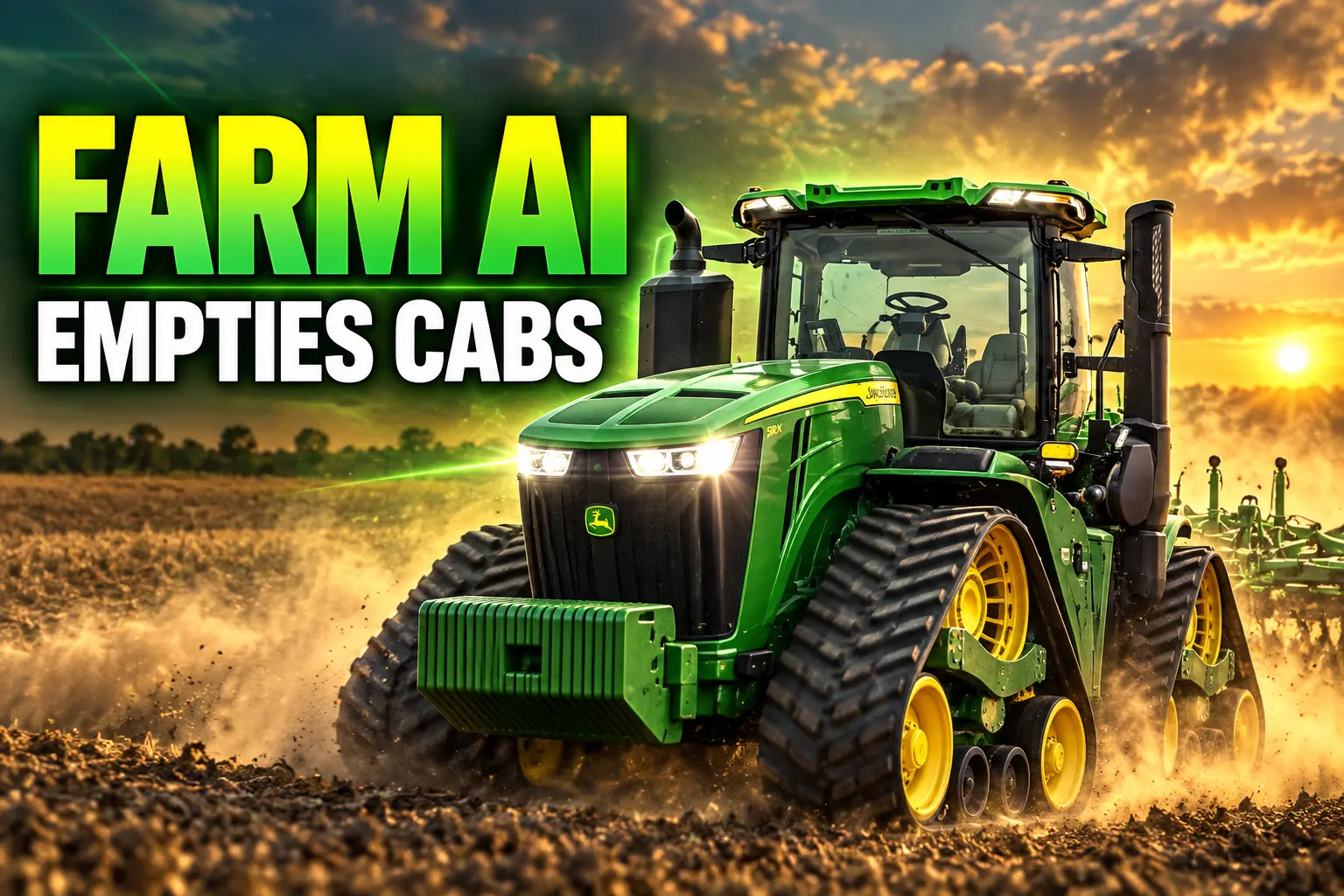
The Association of Equipment Manufacturers split farm AI into Assist, Advise, and Act on September 10, 2026, as machines began working fields with empty cabs. The Milwaukee trade group’s paper, From Assistance to Autonomy: How AI Is Changing Agricultural Equipment, treats software as a built-in part of the iron, not a add-on screen.
Each rung also reassigns who holds the wheel, who owns the advice, and who is on the hook when a pass goes wrong.
Three Jobs for Farm AI, One Operator Left in Charge
AEM’s Ag Technology Leadership Group wrote the paper. Austin Gellings, senior director of agricultural services, said AI is already helping farmers stay productive and competitive as farm pressures pile up. He added that the same tools, used with “appropriate frameworks,” can back farm-level strength and a stable food supply.
The group does not describe a single switch from hand controls to a robot. It names three jobs the software can take.
THE THREE JOBS AEM ASSIGNED TO FARM AI
| Level | What the software does | Who stays in charge | Field example in the paper |
|---|---|---|---|
| Assist-Level AI | Supports the pass through guidance, implement control, and automated functions | The operator | Auto-steer and automated equipment functions |
| Advise-Level AI | Reads large volumes of machine and farm data and offers advice | The operator, acting on a recommendation | Decision support and predictive maintenance |
| Act-Level AI | Carries out tasks with greater autonomy | The machine, with a person watching from the cab or a screen | Targeted spray and autonomous field work |
Those use cases already sit in the paper’s own list: operator decision support, predictive maintenance, data-driven improvement, precision spraying, and autonomous equipment operation. Gellings has also said that targeted spray and full autonomous systems both fail without clean, usable data feeding the models.
AEM posted the paper the same afternoon.
From the field to the farm office, AI is changing how decisions get made across agriculture.
As technology evolves, farmers are gaining new tools to improve productivity, manage resources more effectively, and maximize equipment uptime. Explore the opportunities, challenges, and… pic.twitter.com/FyOgWq0Ike
— Association of Equipment Manufacturers (AEM) (@aemadvisor) September 10, 2026
Control Moves off the Seat With Every Rung
Assist-level AI is the world most large farms already bought. The tractor still needs a person. The software holds the line, runs the boom sections, and takes over repeatable motions so the driver can watch the implement.
Advise-level AI is a different product. Hours of CAN traffic, yield maps, fault codes, and weather feeds become a suggestion: skip this pass, change this rate, pull this machine before it grenades in the field. The farmer still says yes. The model that produced the yes lives on someone else’s stack.
Act-level AI is the jump the title advertises. Targeted spray and driverless field work mean the machine is no longer waiting for a thumb on a button. Liability, insurance, and the service call move with it. So does the training data from every acre the machine just ran.
By turning data into action and helping farmers respond to changing conditions in real time, AI is becoming an essential tool for advancing productivity and supporting food security for the future.
Seth Zentner, Chair, AEM Ag Technology Leadership Group
Zentner is a precision farming and systems engineer at CLAAS, Inc. His line is the paper in one breath: data in, action out. The person who owns the model owns the action.
AEM’s earlier autonomy guidance still says an operator can take control at every level it lists. Nick Libbi, director of CE strategic accounts at CNH Industrial, put the same idea in plainer words in 2025: automation and autonomy, he said, are about making operators safer and more productive, and they are not about taking people out of seats. Empty-cab tillage kits are for sale anyway.
Connected machines placed on the market after September 12, 2026, two days after AEM’s paper, also fall under the EU’s access-by-design rules for connected machines. Raw data generated in use is in scope. The insight layer built on top of that data is the part makers still treat as their own.
Who Wrote AEM’s Farm AI Paper?
AEM is the North America-based trade group for off-road equipment makers and suppliers. It counts more than 1,000 companies and more than 200 product lines. It says the U.S. equipment manufacturing industry supports over 2.2 million jobs and puts $415 billion into the economy each year. The paper is a manufacturers’ document, written for a sector that sells the machines the rungs describe.
The up to 15 equipment-company representatives on the Ag Technology Leadership Group did the work. The chair is Zentner. The vice chair is Brett McMickell of Kubota North America. Gellings is the AEM staff lead. The group lists automation and autonomous systems, data and machine sharing, and cybersecurity as its primary goals, with connectivity, public outreach, power, and carbon as support work. It meets two or three times a year.
AEM AT A GLANCE
- Members: More than 1,000 companies and more than 200 product lines across farm and construction gear.
- U.S. footprint: Over 2.2 million jobs and $415 billion a year, per AEM’s own count for the equipment industry.
- The writing group: Up to 15 people from member tech teams, chaired by CLAAS, with Kubota as vice chair.
- Stated goals: Autonomy, data sharing between machines, and cybersecurity, then connectivity and public outreach.
That roster explains the tone. The paper talks about farm resilience and food security. The people in the room sell tractors, sprayers, combines, and the software subscriptions that now ride along.
The timing also sits on a soft market. AEM’s own November 2025 flash showed U.S. agricultural tractor sales down 19.6 percent from November 2024, with combine sales down 35.2 percent. Gellings’s line about intensifying operational challenges is not abstract. Dealers are moving iron in a down year, and AI upgrades are one of the remaining things a maker can sell on a machine that already has auto-steer.
600,000 Sprayer Hours and Empty Tillage Cabs
Act-level work is no longer a CES demo. It is still narrow. Tillage on Midwest corn and soybean ground is the beachhead. Orchard spraying is further along. Lights-out farming with nobody watching overnight is not a product the major makers will sell you.
WHERE ACT-LEVEL AI IS ALREADY ON THE CLOCK
| System | Job in the field | How it is watched | Scale on the record |
|---|---|---|---|
| John Deere 8R and 9R tillage upgrade | Seedbed tillage with nobody in the cab | Remote monitoring by phone | Listed at $40,000 to $45,000, plus a $10,000 yearly fee |
| GUSS orchard sprayers | Precision spray in orchards and vines | One person for up to 8 machines | 600,000 autonomous hours and 2.8 million acres, per Deere |
| U.S. Sugar fleet on Deere tractors | Sugarcane land prep and cultivation | Unmanned, up to 24 hours, 7 days | Four 8R units and one 9R on 255,000 acres after an 18-month pilot |
| PTx Trimble OutRun | Grain cart and tillage retrofit | Dealer-installed kit on mixed fleets | Sold through AGCO dealers; Fendt factory integration in model year 2026 |
Deere told investors the GUSS sprayers alone had logged 600,000 autonomous hours and covered more than 2.8 million acres. One person can run up to eight of those machines from a laptop. That is Act-level AI with a supervisor in a pickup, not a second driver in a second cab.
U.S. Sugar put the same idea on a bigger map. The company said it is running four John Deere 8R tractors and one 9R, fitted by Autonomous Solutions, Inc., across 255,000 acres of South Florida cane after an 18-month pilot. The tractors do land prep and cultivation and can run around the clock. That fleet is five machines, not a robot army, and it still needs a human watch. It is also a working answer to the labor squeeze the paper names without pricing it.
Deere’s own tillage upgrade for current and prior 8R and 9R machines was listed in the $40,000 to $45,000 range, with a $10,000 yearly fee for unlimited acres. AGCO’s OutRun kit, which won a 2025 Davidson Prize with ASABE and AEM, started as a grain-cart retrofit and added tillage. Fendt’s 1000 Vario Gen4 line for model year 2026 ships autonomy-ready with factory PTx kits. The cab can be empty. Someone still pays a subscription so the cameras stay live.
Safety Rules Written for a Person in the Cab
The paper’s “responsible deployment” chapter points at standards, safety rules, sharing work, and governance. AEM has been in that process since 1968. The gap is that the safety rule most people can name still assumes a driver.
auto-guidance systems that still need a driver are the subject of ISO 10975:2023, a six-page second edition. It covers factory-fit and retrofit auto-steer on operator-controlled tractors and self-propelled machines. It does not apply to guidance on machines that do not need an onboard operator for primary control. Assist-level AI has a rulebook. Act-level AI does not live in that document.
The series that tries to cover the empty cab is ISO 18497-1 through 18497-4, on the safety of partly automated, semi-autonomous, and autonomous farm machinery. AEM also published six levels of non-road autonomy with its construction-tech counterparts, running from Level 0 manual operation to Level 5 unsupervised autonomy. That ladder is about the machine. The new paper’s three rungs are about the software’s job. They are not the same chart, and treating them as one is how a guidance system gets sold as a driverless tractor.
THE RULES AROUND THE EMPTY CAB
- 1968: AEM begins advocating in the consensus standards process for off-road equipment.
- September 2023: ISO 10975:2023 republishes auto-steer safety for machines that still need a person on board.
- 2025: AEM’s Ag and CE technology groups issue common-language sheets on autonomy, data layers, and machine-data security.
- 2026: AEM’s state agenda keeps staff in California’s Cal/OSHA advisory work on autonomous agricultural tractors, pushing for safety rules it calls realistic for farm use.
- September 10, 2026: The Assist, Advise, Act paper is released.
- September 12, 2026: EU access-by-design duties apply to connected products placed on the market after that date.
Sam Rathburn, AEM’s technical manager for safety and product leadership, has described autonomy standards as the next center of gravity after years of work on rollover and earth-moving rules. California is the live test. If Cal/OSHA writes a human-supervision rule that is tighter than the kits already in dealer lots, Act-level AI stays a Midwest tillage toy.
Repair Files Must Match What Dealers Get
On July 8, 2026, the Federal Trade Commission and five states closed an antitrust case against Deere & Company in the U.S. District Court for the Northern District of Illinois. The commission vote on the stipulated order was 2-0. Illinois, Arizona, Michigan, Minnesota, and Wisconsin joined. The order runs 10 years, and it can be stretched if Deere breaks it.
Deere must give farmers and independent shops the same diagnostic tools as Deere dealers, on fair and reasonable terms, including a check on whether farmers can actually afford them. Chairman Andrew N. Ferguson said those tools have to be in their hands by the end of 2026.
WHAT THE 10-YEAR DEERE ORDER OPENS
- Fault codes: Reading, clearing, and resetting electronic faults that used to sit behind dealer software.
- Pairing: Reprogramming electronic parts, including pairing a new module with the machine.
- Limp mode: Restarting a machine after an emissions-related shutdown.
- The manuals: Technical documents, troubleshooting notes, product improvement programs, and DTAC solutions.
Willie Cade, a Repair.org board member, said the order gives farmers real hope and that his group will watch whether the files actually show up in shops. The order is about diagnosis and repair. It does not hand a farmer the Advise-level model that tells the sprayer which weed to hit, and it does not open the Act-level perception stack on an 8R. Operators still talk as if they cannot fix the tractor they already paid for, because a code reader is not the same as the insight that now runs the pass.
Right to repair was the fight over the toolbox. The next fight is who controls the recommendation that toolbox now serves.
Look at the Hitch Before the Next Cab
A farm-equipment talk in 2026 put the money on a blunt line: the winner in autonomy is whoever solves implement autonomy first. A driverless tractor that cannot talk to the planter, the ripper, or the cart is a very expensive way to idle. Carbon Robotics launched an Autonomy Ready program so implement makers can certify gear for driverless tractor work. Great Plains Manufacturing joined as the first member, with a plan to show a Great Plains HT1100 Terra-Max fitted with a Carbon kit.
That is the Advise-to-Act seam in hardware form. The cab can be empty. If the hitch is still a closed brand island, the farmer bought a subscription to wait. Mixed fleets, which are the reality on most large places, need the plow and the tractor to share a map, a speed, and a stop command. AEM lists data and machine sharing as a primary goal of the same group that wrote the AI paper. The paper does not say who has to open the port.
Driverless tractor demos are now ordinary field-day fare. An Ornata machine was on show in Australia in early September 2026. Night robots that kill pests with UV-C instead of chemistry are already sold as a service in California strawberries. The Act-level future is not only a green tractor with cameras on the roof. It is also a swarm of implements and specialty machines that may never wear a major maker’s badge.
AEM gave the industry a shared vocabulary on September 10, 2026. Assist, Advise, and Act will show up in dealer pitches and in hearings. The rungs that matter in the field are the ones that decide whether the person who still owns the land also owns the advice the machine just followed.

Windows 11 Search Can Now Run the PC Itself

France Pauses Stun Grenades After a Familiar Kind of Injury

Amazon Buys the Emmys as a Global Storefront

Atlassian’s 9.3 File-Read Bug Repeats a 2021 Exploited Flaw

Winklevoss Files a Zcash ETF Around Its Own Stack

Tozorakimab Opens a COPD Lane Other Biologics Shut

Astro City Still Pays Off a 1995 Superhero Wager

Acetaminophen Liver Injuries Soared After a Narrow FDA Cap

Calvin Klein’s Record Jung Kook Collab Could Not Lift Sales

Sony’s 10 Percent Disc Cut Leaves New Games Digital
-
 NEWS1 month ago
Tozorakimab Opens a COPD Lane Other Biologics Shut
-
 ENTERTAINMENT2 months ago
Astro City Still Pays Off a 1995 Superhero Wager
-
 NEWS2 months ago
Acetaminophen Liver Injuries Soared After a Narrow FDA Cap
-
 BUSINESS1 month ago
Calvin Klein’s Record Jung Kook Collab Could Not Lift Sales
-
 GAMING1 month ago
Sony’s 10 Percent Disc Cut Leaves New Games Digital
-

 BUSINESS1 month ago
Trump’s Embargo Threat Spends the Leverage It Needs
-

 ENTERTAINMENT2 months ago
Lionel Richie Faces Heart Tests After the Muny Show
-

 NEWS1 month ago
Texas Puts a Human on Every Consequential AI Decision