
NEWS
Scholar Rock’s Isembyld Becomes the First SMA Muscle Drug
The FDA cleared Isembyld as an SMA muscle add-on after patients on SMN2 drugs still lost motor function, a year after a plant rejection.

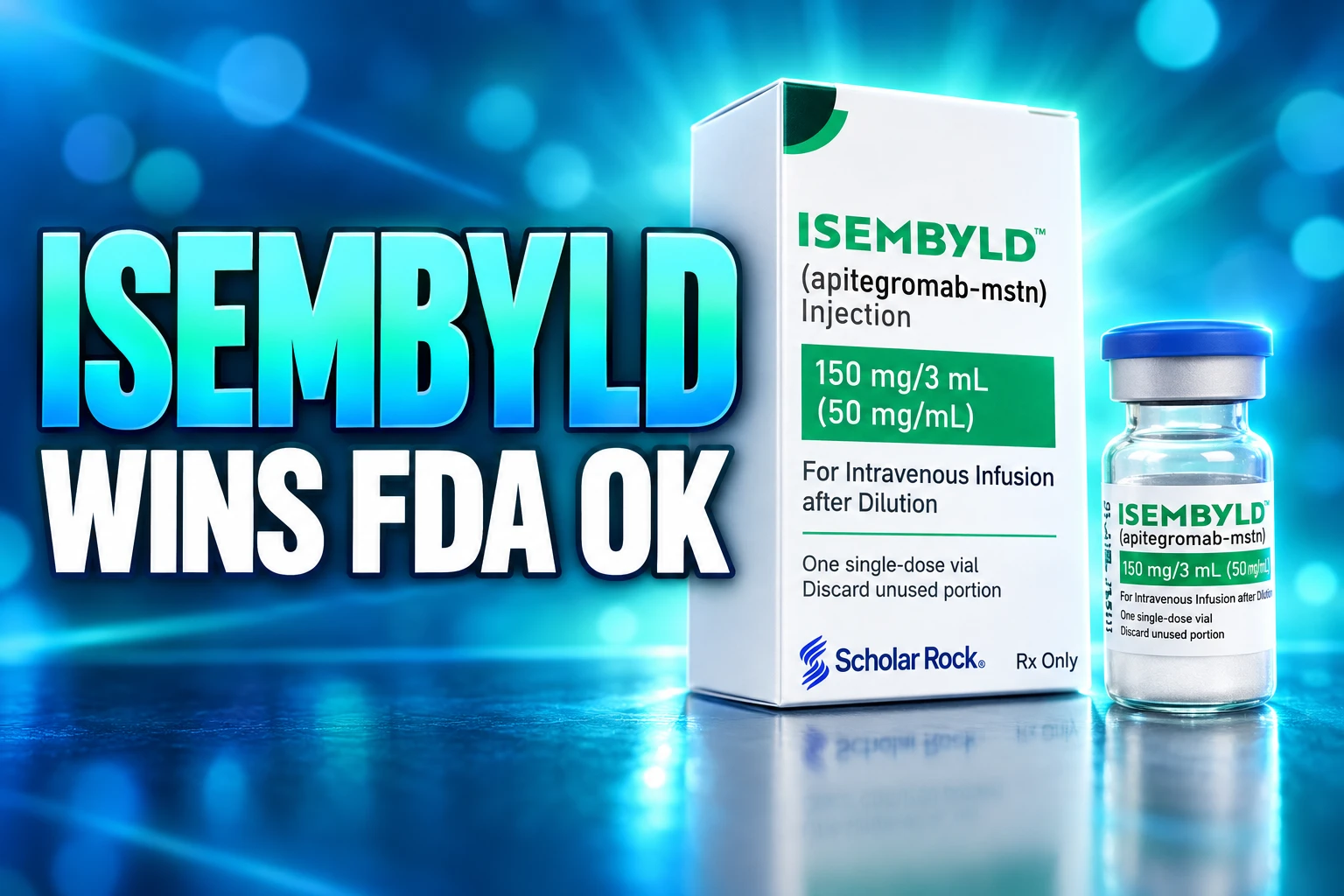
The Food and Drug Administration on Sept. 11, 2026, approved Isembyld (apitegromab-mstn) for spinal muscular atrophy in people 2 and older who already take an SMN2-targeted drug. Scholar Rock’s antibody is the first muscle-targeted SMA treatment cleared in the United States.
In the SAPPHIRE trial, the recommended 10 mg/kg dose beat placebo by a 2.2-point Hammersmith gap at one year. Patients who stayed on SMN2 therapy alone lost motor function on the same scale.
Patients on Spinraza Still Lost Motor Function
Spinal muscular atrophy is a genetic disorder that weakens voluntary muscles because motor neurons die. The Muscular Dystrophy Association estimates about 10,000 children and adults in the United States live with it. Scholar Rock says about 35,000 people worldwide have already received an SMN-targeted medicine.
Those medicines changed survival. Nusinersen (Spinraza) and risdiplam (Evrysdi) act on SMN2. Onasemnogene abeparvovec (Zolgensma) replaces SMN1 with a one-time gene therapy. They do not rebuild muscle that has already wasted, and they do not stop every later decline.
SAPPHIRE enrolled only people who were already on nusinersen or risdiplam and could not walk on their own. The placebo group, still on those background drugs, posted a least-squares mean Hammersmith drop of 1.2 points over one year. That number is why a muscle drug had a market.
Isembyld is a fully human IgG4 antibody. It binds promyostatin and latent myostatin so the mature “brake” on muscle growth is not released. David L. Hallal, Scholar Rock’s chairman and chief executive, tied that design to a long industry stall.
After decades of failed industry-wide efforts to unlock the potential of myostatin inhibition, Scholar Rock has delivered a therapeutic breakthrough with ISEMBYLD.
David L. Hallal, Chairman and CEO, Scholar Rock press release, Sept. 11, 2026
Pfizer’s domagrozumab, Wyeth’s MYO-029, and Roche’s emugrobart all failed to turn myostatin blockade into a reliable function gain, including in SMA for emugrobart. Scholar Rock’s bet was narrower: hit the latent forms, spare related TGF-beta proteins, and add the antibody on top of SMN2 care rather than replace it.
Dr. Basil Darras, associate neurologist-in-chief at Boston Children’s Hospital and a SAPPHIRE investigator, said families already rank motor function first.
As neurologists, families consistently tell us that their top priority is gaining motor function, and we are now able to directly target the muscle, not just the motor neuron, for people living with SMA.
Dr. Basil Darras, Boston Children’s Hospital, Scholar Rock press release
What the SAPPHIRE Trial Showed
SAPPHIRE (NCT05156320) randomized 188 patients across nine countries, ages 2 to 21, in a 1:1:1 split to 20 mg/kg, 10 mg/kg, or placebo, given by vein every four weeks for about a year. Everyone was on nusinersen or risdiplam. Everyone was nonambulatory. The trial started April 14, 2022, and finished Dec. 18, 2024.
The main efficacy group was ages 2 to 12 (n=156). The label comparison for the recommended dose is 53 people on 10 mg/kg versus 50 on placebo (n=103). Ninety-nine percent of that younger group finished the year.
SAPPHIRE AT ONE YEAR
| Result (ages 2 to 12) | Isembyld 10 mg/kg (n=53) | Placebo (n=50) |
|---|---|---|
| HFMSE vs placebo (LS mean) | 2.2-point difference (p=0.0121) | Reference |
| HFMSE change from baseline (LS mean) | Improvement vs placebo | -1.2 points |
| ≥3-point HFMSE rise | 34.2% | 13.5% |
| Odds of a ≥3-point rise | 3.8 | 1.0 |
| Fractures | 9% (5 of 53) | 2% (1 of 50) |
The Hammersmith Functional Motor Scale Expanded scores 33 tasks, from sitting unassisted to standing and walking. A 3-point rise is the bar Scholar Rock and many SMA trials treat as a function gain a family can feel. 34.2% of the 10 mg/kg group cleared that bar, against 13.5% on placebo (p=0.0125).
The 10 mg Dose Beat Placebo
The 2.2-point gap is a nominal p-value of 0.0121. The company and the label both flag it as nominal. The 20 mg/kg arm, twice the recommended dose, did not add function, so the label tells doctors not to use it. Target engagement looked similar at both doses in the 2-to-12 group.
People 13 to 21 received 20 mg/kg and showed a trend in the same direction as the younger 10 mg/kg group. The approved indication still covers adults and older teens who are on an SMN2 drug, using pharmacokinetics and latent-myostatin levels to bridge from the younger cohort.
Most Patients Stayed on the Drug
Ninety-eight percent of SAPPHIRE participants who got Isembyld chose the ONYX long-term extension. The safety file covers more than 500 people across studies, some treated for more than 7 years. One of 128 patients in Study 1 (0.8%) had a treatment-emergent anti-drug antibody at a single time point, with no neutralizing antibodies found.
Kenneth Hobby, president of Cure SMA, said the FDA’s broad age cut, 2 and older rather than only the nonambulatory children in the primary analysis, matched what families had asked for: a muscle option, not another SMN product.
A Catalent Plant Cost Patients a Year
The science was not the delay. On Sept. 23, 2025, the FDA issued a complete response letter that cited inspection findings at Catalent Indiana LLC, a fill-finish plant in Bloomington that Novo Nordisk had bought in December 2024. The letter did not question efficacy, safety, or the drug-substance site. The observations were not specific to apitegromab.
Novo’s plant drew a Form 483 in July 2025 and a warning letter in November 2025. Scholar Rock resubmitted in late March 2026 with two fill-finish sites. The FDA accepted that file on May 7, 2026, and set a Sept. 30, 2026, action date.
THE PATH TO THE SEPT. 11 CLEARANCE
- December 2024: Novo Nordisk closes its purchase of the Catalent Indiana fill-finish plant.
- September 23, 2025: FDA sends a complete response letter tied only to that plant’s inspection.
- Late March 2026: Scholar Rock resubmits the biologics license application with two fill-finish sites.
- May 7, 2026: FDA accepts the resubmission and sets a Sept. 30 action date.
- August 7, 2026: The agency classifies an April 2026 Catalent reinspection as Official Action Indicated; Scholar Rock drops the plant from the file.
- September 11, 2026: FDA approves Isembyld, 19 days before the action date.
The second plant already made other commercial products and had recent FDA and EMA inspections on file. Hallal said commercial vials from that site were waiting at a packager. The approval also came with a Rare Pediatric Disease Priority Review Voucher.
Shares closed at $55.41 on Friday, Sept. 11, then rose $6.56, or 11.84%, to $61.97 after hours. The company has not posted a list price. Management will take questions at 8:00 a.m. ET on Monday, Sept. 14, 2026.
How Isembyld Is Given
The recommended dose is 10 mg per kilogram every four weeks as an intravenous infusion over about 60 to 120 minutes, no faster than 150 mL per hour. Each single-dose vial holds 150 mg in 3 mL (50 mg/mL). A clinician dilutes the drug in 0.9% sodium chloride to 5 mg/mL before hanging it.
THE INFUSION RULES ON THE LABEL
- Who: Adults and children 2 and older who are currently on an SMN2-targeted treatment.
- Where: Hospital, home, or infusion center, based on eligibility and payer rules.
- Missed dose: Give it as soon as possible and reset the four-week clock, or skip to the next scheduled day.
- Bone risk: Use caution if the patient has low bone density or several prior fractures; stop-or-continue is a clinical call after a new break.
Scholar Rock Supports is live at 833-777-5444 to help with coverage, copay aid, and infusion logistics. Product is set to ship in the coming days. There are no contraindications. Animal data flag possible fetal harm and effects on reproductive function.
The fracture warning is the safety item that will follow the drug into clinic. In Study 1, 5 of 53 patients on 10 mg/kg (9%) had fractures, against 1 of 50 on placebo (2%). Three femur fractures occurred on Isembyld. In an open-label extension at 20 mg/kg, 22 patients (9%) had fractures, including 5 serious femur events. Some breaks had no clear fall. Rat studies found femoral-head damage at exposures below the human dose.
Upper respiratory infections, vomiting, cough, other viral infections, headache, gastroenteritis, pharyngitis, and hypersensitivity were the common reactions (at least 20% and more than placebo). Serious pneumonia occurred in three patients on 10 mg/kg and none on placebo. Mean creatine phosphokinase rose 91 U/L on drug versus 3 U/L on placebo.
Europe Withdrew the File Over the Same Factory
U.S. patients get a launch. Europe does not. Scholar Rock Netherlands B.V. withdrew the European file on August 13, 2026, after the Catalent site failed to show EU good manufacturing practice in time. The European Medicines Agency’s provisional view at withdrawal was that the medicine could not be authorized on that manufacturing record.
The company told the agency it will come back with the alternate plant. Until that resubmission moves, the muscle add-on that U.S. doctors can order next week is not on the EU market. Clinical-trial and compassionate-use patients were told the withdrawal does not cut their supply.
That split will shape the first year of sales. Scholar Rock had talked about a German launch in the second half of 2026. That calendar is now a new filing, not a launch.
The Label Stops at SMN2 Drugs
The indication is tight in one way the launch headlines skip. Isembyld is only for people “currently receiving” an SMN2-targeted treatment. SAPPHIRE allowed nusinersen or risdiplam and barred anyone who had ever received Zolgensma. Gene-therapy patients are outside the trial and, as written, outside the label unless they also take an SMN2 drug.
The FDA’s own account stressed the add-on design.
Today we approved Isembyld, the first therapy to directly target muscle weakness linked to muscle loss in patients with the rare disease of spinal muscular atrophy (SMA). Designed to work alongside existing SMA treatments, it helps patients age 2 and older improve their strength… pic.twitter.com/20sEiBbvk1
— FDA Drugs and Biologics (@FDADrugs) September 11, 2026
A parent of a 5-year-old with SMA Type 2 already asked, in public, for “this gene therapy.” Isembyld is not gene therapy. It is a monthly antibody hung on top of Spinraza or Evrysdi. Mixing those products up will be the first clinic conversation, and it is a fair one: the gene-therapy generation is large, and this label does not automatically include them.
WHAT THE APPROVAL SETTLES
- U.S. use: Ages 2 and older, on SMN2 therapy, 10 mg/kg IV every four weeks.
- Trial core: Nonambulatory Type 2 and Type 3 SMA; primary numbers from ages 2 to 12.
- Open items: List price, payer criteria, and a fresh European application.
- Off the label for now: Children under 2, and patients whose only disease-modifying drug is Zolgensma.
The 2.2-point gap is modest on a 66-point scale. It is also the first time a muscle drug has moved that scale in SMA patients who were already on the standard SMN2 pair. Placebo’s 1.2-point slide is the other half of the same result. For a community that spent a decade celebrating survival, the leftover problem is now a billed infusion.
Vials are due to ship in the coming days. The price, and how payers treat a fourth SMA product stacked on drugs that already cost six figures, is the question Hallal’s team has to answer on Sept. 14.
Frequently Asked Questions
Can children younger than 2 years take Isembyld?
No. The FDA says safety and effectiveness have not been established in patients younger than 2, and SAPPHIRE did not enroll that age group. Newborns and infants remain on SMN2 drugs or gene therapy under those products’ own labels.
What is the Hammersmith scale’s top score?
The Hammersmith Functional Motor Scale Expanded sums 33 scored activities into a total from 0 to 66, with a higher number meaning better motor function. Sitting without help, standing, and walking are among the items; SAPPHIRE required a baseline score between 10 and 45.
Is Isembyld a gene therapy like Zolgensma?
No. Isembyld is a monoclonal antibody given by vein every four weeks that blocks latent myostatin. Zolgensma is a one-time SMN1 gene replacement, and SAPPHIRE excluded anyone who had ever received it, so gene-therapy-only patients are not in the approved population unless they also take an SMN2 drug.
What does the label say about pregnancy?
Based on animal data, Isembyld may cause fetal harm and may affect reproductive function in females and males. It is not known whether the antibody passes into breast milk; the label tells patients to talk with a clinician before becoming pregnant or while feeding an infant.
How should a missed infusion be handled?
The label offers two paths: give the missed dose as soon as possible and restart the four-week schedule from that day, or skip it and wait for the next planned visit so the original calendar stays intact. The diluted bag, if not hung at once, may be held up to 4 hours at room temperature or in a refrigerator, including prep and infusion time, and must not be frozen.
Disclaimer: This article is news reporting on an FDA approval and the SAPPHIRE trial. It is for information only and is not medical advice, a treatment recommendation, or a substitute for care from a neurologist or other qualified clinician who knows the patient’s history. Families considering Isembyld should review the full prescribing information with their SMA care team, including fracture risk, infusion logistics, and whether the person is on an SMN2-targeted drug. Figures, the U.S. label, and European status reflect the company, FDA, and EMA materials available on Sept. 11 and 12, 2026, and may change if the label is updated or if payers set different coverage rules.

Fox Pulls Barstool Off Big Noon After Ohio State Pressure

Fashion Loses Its Green Buzzwords Without a Common Score

Meta One Puts Extra AI and Plus Apps on One Bill

Brewers Clinch First NL Central Four-Peat and Chase 1982

Reba Brings Dolly’s Mountain Song Back to the Emmys

Astro City Still Pays Off a 1995 Superhero Wager

Tozorakimab Opens a COPD Lane Other Biologics Shut

Acetaminophen Liver Injuries Soared After a Narrow FDA Cap

Calvin Klein’s Record Jung Kook Collab Could Not Lift Sales

Lionel Richie Faces Heart Tests After the Muny Show
-
 ENTERTAINMENT1 month ago
Astro City Still Pays Off a 1995 Superhero Wager
-
 NEWS4 weeks ago
Tozorakimab Opens a COPD Lane Other Biologics Shut
-
 NEWS1 month ago
Acetaminophen Liver Injuries Soared After a Narrow FDA Cap
-
 BUSINESS4 weeks ago
Calvin Klein’s Record Jung Kook Collab Could Not Lift Sales
-

 BUSINESS4 weeks ago
Trump’s Embargo Threat Spends the Leverage It Needs
-
 ENTERTAINMENT1 month ago
Lionel Richie Faces Heart Tests After the Muny Show
-

 NEWS4 weeks ago
Texas Puts a Human on Every Consequential AI Decision
-

 NEWS1 month ago
UCLA Bets Its Athletic Future on an Unpaid Lakers Executive