
LIFESTYLE
Fashion Loses Its Green Buzzwords Without a Common Score
EmpCo starts 27 September 2026 and bans vague fashion green claims after Brussels stalled a science-check law for labels.

From 27 September 2026, any fashion brand selling to EU shoppers must stop using bare green claims it cannot prove on the same label. The Empowering Consumers for the Green Transition directive, EmpCo, treats vague words, house eco-badges and offset-based carbon-neutral tags as unfair commercial practices in all 27 member states.
A wider law that would have forced a scientific check before those claims went live never made it onto the books. What arrives instead is a blacklist that will change who is still allowed to talk.
Fashion Gets a Speech Ban Without a Measuring Stick
EmpCo is the blacklist added to EU consumer law, not a new lab test for every T-shirt. Directive (EU) 2024/825, adopted on 28 February 2024, amends the Unfair Commercial Practices Directive. Member states had until 27 March 2026 to write it into national law. The Commission’s consumer pages set out when the new consumer rules apply: 27 September 2026, with no grace period by size of firm.
That date is the leftover tool. On 22 March 2023 the Commission proposed a separate Green Claims Directive that would have required many explicit green claims to be checked by an accredited verifier before they reached a shopper. On 20 June 2025, Commission spokesperson Maciej Berestecki said the executive intended to pull that file.
In the current context, indeed the Commission intends to withdraw the Green claims proposal.
Maciej Berestecki, European Commission spokesperson, 20 June 2025
Council negotiators then cancelled the 23 June 2025 trilogue. The stated worry was burden on about 30 million micro-enterprises. EmpCo itself has no such carve-out. A one-person label shipping into the EU faces the same banned phrases as a fast-fashion giant.
Andreas Rasche, associate dean at Copenhagen Business School, has called the remaining text surprisingly thorough for EU consumer law, because it names the tricks instead of leaving them to taste. The gap is the missing yardstick. EmpCo tells brands what they may no longer say. It does not give shoppers one shared method for comparing two jackets.
HOW THE SPEECH BAN ARRIVED
- 2020: A Commission study of 150 environmental claims finds 53.3% vague, misleading or unfounded and 40% with no supporting evidence.
- January 2021: A website sweep of 344 sustainability claims finds authorities had reason to treat 42% as exaggerated, false or deceptive.
- 22 March 2023: The Commission proposes the Green Claims Directive, a pre-check system for explicit green marketing.
- 28 February 2024: Parliament and the Council adopt EmpCo as Directive (EU) 2024/825.
- 20 June 2025: The Commission says it intends to withdraw the Green Claims file; the 23 June 2025 trilogue is cancelled.
- 27 March 2026: The deadline for national transposition of EmpCo passes.
- 27 September 2026: The new unfair-practices rules apply across the EU.
National consumer bodies will still run the cases. Some transposing bills were still moving in late September, including in Spain, but the application date is Union-wide. For a widespread cross-border breach, the Unfair Commercial Practices Directive already requires a maximum fine of at least 4% of annual turnover, or at least EUR 2 million when turnover cannot be shown. The Netherlands and Poland can go as high as 10%.
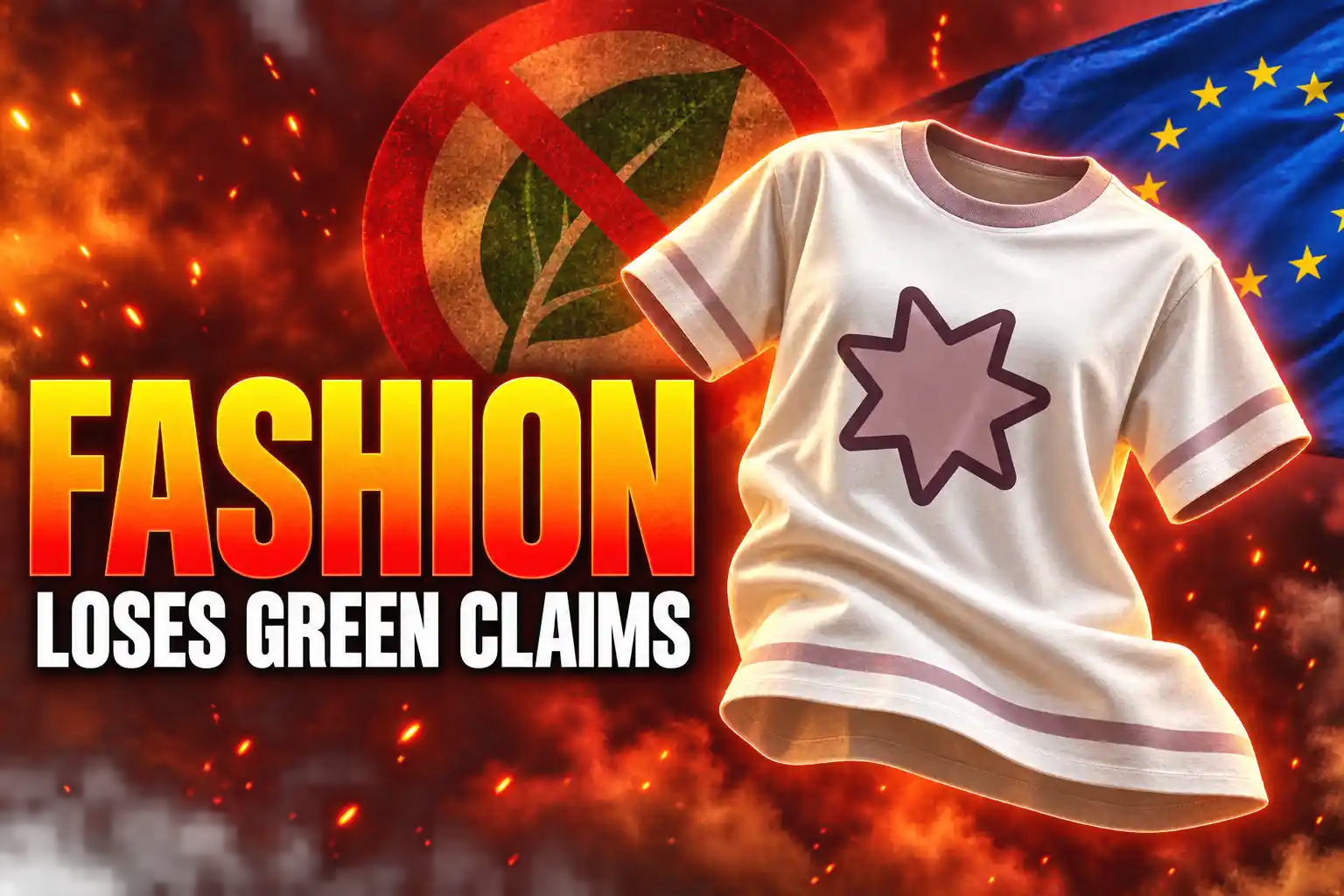
What Sunday’s Rules Ban on a Product Page
The legal test is what an average shopper would take the message to mean, including images and colour. Constantin Eikel, a partner at Bird & Bird in Düsseldorf, has been blunt with apparel clients: a qualifier buried one click away does not rescue a headline word. The specification has to sit on the same webpage, label or advert.
The Commission’s September 2026 Commission questions and answers on EmpCo walk through the same line. A claim is generic when it suggests excellent environmental performance without saying how. “Climate-friendly packaging” fails. “100% of energy used to produce this packaging comes from renewable sources” is specific, and then other misleading-practice rules still apply to that sentence.
CLAIMS THAT DIE ON 27 SEPTEMBER
| Practice on a fashion page | Legal result from 27 September 2026 |
|---|---|
| Bare “sustainable”, “green”, “eco-friendly” or “conscious” with no proof on the same medium | Banned as a generic environmental claim unless recognised excellent environmental performance is shown |
| “Recycled T-shirt” when only the thread or label is recycled | Banned as a whole-product claim that covers only a part |
| “Carbon neutral” or “climate neutral” because the brand bought offsets | Banned outright, whatever the quality of the credits |
| A house “eco” badge with no independent scheme behind it | Banned as a sustainability label that is not a certification scheme or a public-authority mark |
| “Made with 95% GOTS-certified organic cotton” on the same ticket | Allowed as a specific, checkable claim |
| EU Ecolabel, Blue Angel or Energy Label class A used for the trait they actually measure | Allowed as recognised excellent environmental performance for that trait |
| “Carbon neutral by 2030” with no public plan, targets or third-party progress reports | Banned as an unsupported future-performance claim |
Excellent environmental performance is a short list: the EU Ecolabel, officially recognised EN ISO 14024 schemes such as Germany’s Blue Angel, or the top band under other Union law, such as Energy Label class A. Recital 10 of the directive is explicit that “conscious”, “sustainable” or “responsible” cannot rest on that environmental proof alone, because those words also pull in social issues.
Social claims are in the statute, not a side note. Recital 3 lists working conditions, wages, safety, human rights, equal treatment and animal welfare as product characteristics that can mislead. Alexandra Mihailescu Chicon, global head of market development at RepRisk, has pointed to the firm’s finding that nearly two-thirds of fashion supply-chain risk incidents were social. A “responsible” filter that only tracks recycled polyester will not match that file.
The 20 Percent Who Keep a Sustainability Label
Germany’s implementing notes, attached to the third act amending the Unfair Competition Act, already forecast a thinner shelf. The legislator expects far fewer environmental claims and labels in the market. On sustainability labels, the working assumption is that only around 20% of companies will still meet the criteria for displaying one.
That is a German planning figure, not an EU census. It is still the clearest official guess of what the new gate does. A certification scheme has to be open on fair terms, built with experts and stakeholders, and watched by an independent third party whose competence can be shown under international, Union or national standards, including ISO 17065. A house standard written in a brand’s legal department does not qualify.
The Brussels inventory of environmental claims is why the gate is that tight. The 2020 study put 53.3% of sampled claims in the vague, misleading or unfounded bucket and 40% in the unsubstantiated bucket. The same Commission brief counts 230 sustainability labels in the EU, plus 100 green energy labels, with wildly different levels of checking. Half of green labels, on that count, offered weak or no verification.
THE NUMBERS BEHIND THE CRACKDOWN
- Unfounded claims: 53.3% of 150 environmental claims in the 2020 Commission inventory were vague, misleading or unfounded.
- No evidence: 40% of those claims had no supporting evidence.
- Label clutter: 230 sustainability labels were counted in the EU, many with weak checks.
- Who still qualifies: German implementing notes assume only around 20% of companies will meet the test for showing a sustainability label.
French authorities have already fined Shein EUR 40 million for overstating sustainability efforts. Italian authorities added a EUR 1 million fine. Those cases ran under older national powers. EmpCo now gives every national enforcer the same blacklist, including for non-EU webshops that take euros, list an EU contact or ship into the Union.
Offset-Based Carbon Neutral Tags Lose Legal Cover
Annex I, point 4c, is the cleanest kill shot in the file. A trader may not claim, based on offsetting greenhouse gases, that a product has a neutral, reduced or positive climate impact. Recital 12 and the Commission Q&A add that the quality of the credits does not save the line. The product has to show its own value-chain cut.
That matches a complaint that has followed carbon-neutral gadgets and fashion drops for years. Credits for trees that will not mature for decades have been sold as a present-tense product trait. EmpCo leaves companies free to talk about funding a project, as long as they do not dress the T-shirt itself as climate neutral because of that cheque.
Future promises sit on a different hook. “Climate neutral by 2030” is only lawful if the trader publishes a detailed, realistic plan with measurable, time-bound targets and money attached, and if an independent expert checks progress and those findings are available to consumers. A sustainability-report paragraph recycled into a product page does not meet that test. Corporate reports aimed at investors sit outside EmpCo until someone pastes them into a consumer advert.
Leaves, Filters and Other Silent Claims
The directive’s definition of an environmental claim includes text, pictures, graphics, symbols, labels, brand names and product names. Recital 9 says a written or spoken line combined with colours or images can still be a generic claim. A pale-green product shot with a leaf motif is no longer decoration if the average shopper reads it as a green product.
Search filters and “sustainable” edits are the practical casualty for retailers. Unless every SKU behind the filter carries a scheme or a public label that matches the promise, the collection page is a whole-product claim built on a fraction of the rack. H&M shut its Conscious Collection in late 2022 after Dutch and Norwegian authorities challenged the evidence and a Changing Markets Foundation check found more polyester in the “sustainable” line than in the main line. The Dutch Authority for Consumers and Markets also flagged Decathlon’s “Ecodesign” language. EmpCo turns that kind of edit into a standing legal problem rather than a one-off investigation.
WHAT NOW COUNTS AS A GREEN CLAIM
- The words: Sustainable, green, eco-friendly, climate friendly, conscious and responsible, unless specified on the same medium or backed by recognised excellent environmental performance that actually matches the word.
- The badge: Any sustainability logo that is not a monitored certification scheme or a mark established by a public authority.
- The picture: Leaves, water drops, green washes and similar artwork that imply a better environmental product.
- The name: Brand or product names that suggest an environmental benefit, even if they are trade-marked, if an average shopper would read them that way.
- The filter: Site edits and collections that sort clothes as sustainable when the proof does not cover every item shown.
Pack already in shops is in scope. Industry guidance that tracks the Commission Q&A says brands can cover old print with stickers or add a correction at the till, and that enforcers are likely to weigh whether a trader made reasonable efforts rather than demand a landfill of last season’s swing tickets overnight.
Certifiers Inherit the Microphone Brands Just Lost
If generic adjectives are gone, the remaining vocabulary is a certificate, a government label or a dull, specific sentence. That is a transfer of speech from marketing teams to auditors. Aleksandra Czajka, public procurement specialist at Global Standards, the body behind GOTS, has warned that the lazy reply is silence, and that the useful reply is narrower, better-backed copy. Sandra Capponi, co-founder of Good On You, argues that uncertainty is no longer an excuse; the rules are written. Good On You, which has rated more than 7,000 brands, appointed an independent monitoring body and split its commercial and ratings teams so partners rated “good” or “great” can show a label and build a filter that fits EmpCo.
Oeko-Tex chief executive Alfred Beerli said customers spent a year asking what they could still claim. Global Standards published a practical guide for certified firms. Those bodies now sit where fashion’s old “conscious” drop-down used to sit. They are not a safe harbour. Germany’s notes, citing the Commission Q&A, stress that a sustainability label does not launder a misleading line about offsets or about a whole product that is only green in one seam.
The public-authority route is narrower still. The EU Ecolabel criteria for clothing and textiles cover fibre production, hazardous substances and durability, and the current textile and footwear criteria run to 31 December 2028. An Ecolabel can support a claim that matches those criteria. It cannot turn a shirt into a “sustainable” object in the legal sense, because that word still drags social issues with it.
François-Ghislain Morillion, co-founder of Veja, has treated certificates as a floor, not a finish. Veja publishes material breakdowns and supplier pages, including Fair for Life rubber from the Amazon that makes up 50% of its soles. “For me, it’s a minimum to be certified,” he said. “It does not prove that it’s perfect.” He still wants staff in the mills, because “a certification is just paper.”
Small Labels Get Shein’s Rulebook
EmpCo does not phase in by headcount. The same Annex I points bind a Berlin atelier and a Shenzhen webshop if EU consumers are the target. Mihailescu Chicon’s warning is operational, not literary: every consumer-facing line has to sit on current product and supply-chain data, and the risk is often the factory file, not the slogan. Small labels that already buy GOTS fabric and keep invoices will keep their sentences. Small labels that borrowed “eco” for a lookbook will have to delete it.
Shoppers asked for this and may not thank anyone for the quiet that follows. Zalando’s 2025 It Takes Many report found 71% of surveyed customers wanted more sustainable purchases, then struggled to spot them. VML’s 2026 Future Shopper report found 48% like the idea of a carbon figure on a product and 41% admit they do not fully understand it. Capponi still has a backlog of rating requests. Rasche doubts the public will see the legal plumbing that makes a remaining claim safer. “Trust is something that takes a very long time to develop, but unfortunately, a very short time to destroy,” he said.
On Sunday, 27 September 2026, the EU will have fewer legal ways to call a dress green, and still no single score that tells a shopper which dress is better. The brands that kept the right to speak are the ones that already paid for someone else to check.

Fashion Loses Its Green Buzzwords Without a Common Score

AI Coding Tools Add 180 Percent More Code, Not Users

Anthropic’s Safety Hire Quits, Calling the Race a Gamble

Texas Puts a Human on Every Consequential AI Decision

The IBC Intercom Purchase Now Includes Licenses and Carriers

Astro City Still Pays Off a 1995 Superhero Wager

Acetaminophen Liver Injuries Soared After a Narrow FDA Cap

Tozorakimab Opens a COPD Lane Other Biologics Shut

Trump’s Embargo Threat Spends the Leverage It Needs

Calvin Klein’s Record Jung Kook Collab Could Not Lift Sales
-
 ENTERTAINMENT1 month ago
Astro City Still Pays Off a 1995 Superhero Wager
-
 NEWS1 month ago
Acetaminophen Liver Injuries Soared After a Narrow FDA Cap
-
 NEWS3 weeks ago
Tozorakimab Opens a COPD Lane Other Biologics Shut
-
 BUSINESS3 weeks ago
Trump’s Embargo Threat Spends the Leverage It Needs
-
 BUSINESS3 weeks ago
Calvin Klein’s Record Jung Kook Collab Could Not Lift Sales
-
 NEWS3 weeks ago
Texas Puts a Human on Every Consequential AI Decision
-
 NEWS4 weeks ago
UCLA Bets Its Athletic Future on an Unpaid Lakers Executive
-
 ENTERTAINMENT4 weeks ago
Lionel Richie Faces Heart Tests After the Muny Show