NEWS
Acetaminophen Liver Injuries Soared After a Narrow FDA Cap
Poison-center liver injuries rose from 10.9 to 52.9 per million as combo pills fell and single-ingredient acetaminophen climbed 349% to 380%.

U.S. poison centers logged 220,160 liver injuries from medicines, alcohol, supplements, and other foreign chemicals from 2000 to 2024, as the rate rose from 10.9 to 52.9 cases per million. Acetaminophen taken by itself led the list. The one federal dose cap that moved the numbers never touched that bottle.
Researchers at UVA Health pulled National Poison Data System records on people age 15 and older whose labs showed hepatocellular injury, meaning AST or ALT above 100 U/L. More than 80% of those cases needed inpatient care. Combination prescription products that mix acetaminophen with an opioid fell hard after 2011. Single-ingredient acetaminophen did the reverse, and that is the part the warning headlines skip.
Poison Centers Logged 220,160 Liver Injuries
Eleanor Blair Towers, M.D., of the University of Virginia, is first author on the paper in Clinical Gastroenterology and Hepatology, posted online August 13, 2026. Christopher P. Holstege, M.D., director of UVA Health’s Blue Ridge Poison Center, led the group with Scott Schmalzried and Rita Farah. Their poison center reports of liver injury cover a quarter century of calls, not a single outbreak week.
Women made up 54% of the 220,160 exposures. Medicines drove 85% of cases in men and 94% in women. Acetaminophen on its own was the single substance named most often, tied to 33% of men’s cases and 45% of women’s. After population adjustment, the national rate climbed from 10.9 per million to 52.9 per million, a rise of about 385%, which the UVA release rounds to nearly 400%.
| Measure | Finding |
|---|---|
| Cases, 2000 to 2024 | 220,160 |
| Rate in 2000 | 10.9 per million |
| Rate in 2024 | 52.9 per million |
| Share who were women | 54% |
| Medicine-related, men / women | 85% / 94% |
| Acetaminophen alone, men / women | 33% / 45% |
| Acetaminophen-alone rise, men / women | 349% / 380% |
| Combination-product drop after the cap | 60% to 85% |
| Needed inpatient care | More than 80% |
These are not mild enzyme blips phoned in by worried parents. The study required lab evidence of liver-cell injury, and most patients were admitted. Poison-center files still miss people who never call, so the true count is higher, not lower, than 220,160. What the file does show is a long, even climb rather than a one-year spike.
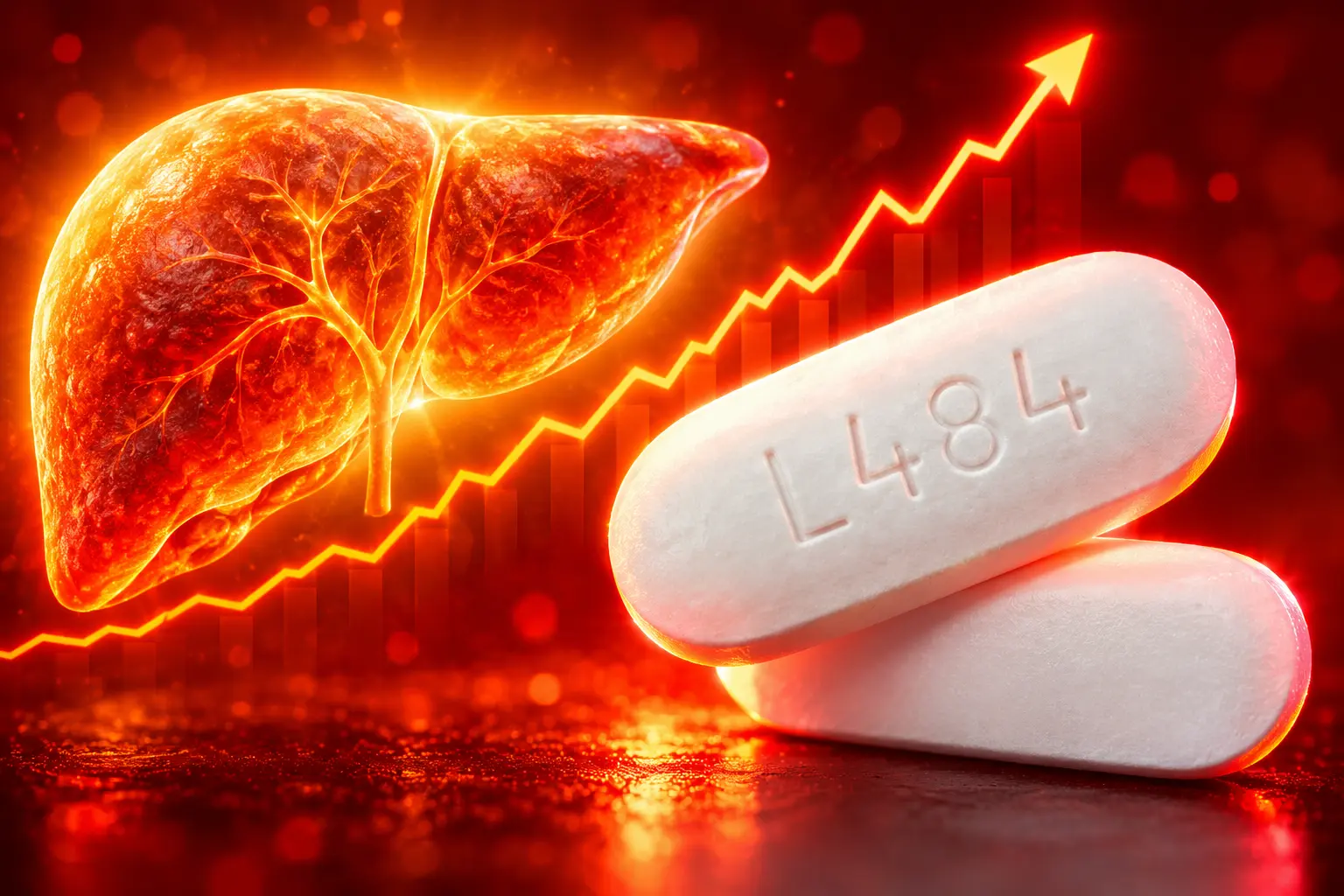
The 325 Milligram Cap Cut Combination Cases
On January 13, 2011, the Food and Drug Administration told makers of prescription combination products to limit acetaminophen to 325 milligrams in each tablet or capsule and to add a boxed warning about severe liver injury. Older pills had carried as much as 750 mg next to hydrocodone or oxycodone. The Federal Register notice said overdoses from those prescription combinations accounted for nearly half of acetaminophen-related liver failure in the United States, and it set a 2014 deadline for the higher-dose versions to leave the market.
The same notice said the change did not apply to over-the-counter acetaminophen. OTC products were about 80% of the acetaminophen market then. Prescription combinations were the other 20%. That split is the whole plot.
THE DOSE RULE, IN ORDER
- June 29 to 30, 2009: An FDA advisory panel votes on OTC dose cuts, a prescription-only switch for the 1,000 mg extra-strength swallow, and a ban on prescription acetaminophen combinations.
- January 13, 2011: FDA asks manufacturers to cap acetaminophen at 325 mg per dosage unit in prescription combination products and to add a boxed warning.
- 2014: Higher-dose prescription combinations are supposed to be gone; JAMA later uses a March 27, 2014 compliance date.
- March 7, 2023: Babak J. Orandi, M.D., Ph.D., Jayme E. Locke, M.D., and the U.S. Acute Liver Failure Study Group report in JAMA that the mandate lined up with a steep drop in combination-product harm.
- August 13, 2026: The UVA team reports combination exposures down 60% to 85% in poison-center liver-injury files, while acetaminophen-alone exposures keep climbing.
Orandi’s group used the National Inpatient Sample and a 32-center ALF cohort. Predicted hospitalizations involving acetaminophen and opioid toxicity fell from 12.2 per 100,000 hospitalizations just before the announcement to 4.4 by late 2019. The share of ALF cases from those combination products fell from 27.4% to 5.3%. Odds of those hospitalizations had been rising 11% a year and then fell 11% a year. The acetaminophen-opioid liver failure share fell on a clock that matches the mandate, not a poster campaign.
A 2009 Panel Wanted Extra Strength Off Shelves
Two years before the 325 mg notice, FDA’s own advisers had asked for a wider cut. Meeting in Adelphi, Maryland, on June 29 and 30, 2009, a joint Drug Safety, Nonprescription Drugs, and Anesthetic and Life Support panel took a run of votes that the agency later declined to copy for the drugstore aisle.
HOW THE 2009 PANEL VOTED
- Daily OTC cap: 21 to 16 to lower the 4,000 mg nonprescription daily maximum; the panel was not asked to name a new number.
- Single adult dose: 24 to 13 to limit the maximum nonprescription single dose to 650 mg, against Extra Strength’s labeled 1,000 mg two-tablet swallow.
- Extra Strength status: 26 to 11 to move the 1,000 mg over-the-counter dose to prescription-only.
- Prescription combinations: 20 to 17 to take Percocet- and Vicodin-style acetaminophen combinations off the market.
- Pack size: 20 to 17 against limiting how many pills go in a bottle.
- OTC combinations: 24 to 13 to keep acetaminophen in drugstore cold and flu mixes such as NyQuil-style products.
- If combos stayed: 36 to 1 for a boxed warning on prescription acetaminophen combinations.
FDA took the last idea, in spirit, and the 325 mg cap. It did not ban the combinations, did not pull Extra Strength behind the pharmacy counter, and did not lower the 4,000 mg daily ceiling that still sits on professional dosing charts. Sandra Kweder, then deputy director of FDA’s new-drug office, said at the 2011 announcement that a ban would have meant disruption for patients in pain and that the agency did not believe it was making the products less effective. The UVA file is what that narrower choice produced 15 years later.
Why Acetaminophen-Alone Injuries Kept Rising
Once the high-dose prescription combinations shrank, the leftover problem was the product you can still buy by the hundred-count bottle. APAP-alone exposures in the poison-center liver-injury set rose 349% in men and 380% in women across the study window. Combination-product exposures fell 60% to 85% after the early-2010s rules. Those two lines crossing is the paper’s actual finding.
Xenobiotic-induced liver injuries reported to U.S. poison centers have steadily increased. The public should be aware of potential liver injury with various substances that are readily available to consumers.
Christopher P. Holstege, M.D., director, UVA Health Blue Ridge Poison Center, UVA Health news release, August 13, 2026
A National Institute of Diabetes and Digestive and Kidney Diseases write-up of the 2023 JAMA analysis said the same split in transplant-level disease: combination acetaminophen-opioid liver failure dropped, and liver failure from acetaminophen alone increased over the same years. Locke’s team told interviewers they did not see the same reduction in acetaminophen-alone cases, which is the comparison that makes the mandate look causal instead of like a general education effect.
Intentional overdose is sitting under that rise. UVA said suspected suicide was the most common reason for exposure in both sexes, and women had higher acetaminophen-associated injury rates than men. A 500 mg tablet is easy to stockpile. A 325 mg prescription combination, after 2014, is not. The 2009 panel had already voted down bottle-size limits, so the United States never used the lever Britain put on paracetamol packs in the late 1990s. This dataset cannot settle how much of the 380% climb is self-harm versus accidental double-dosing, because the opened paper does not print those shares, but the press summary puts suicide first for a reason.
Dose stacking still does the rest. Acetaminophen hides in cold syrups, sleep aids, menstrual formulas, and leftover prescription bottles. Two extra-strength caplets are 1,000 mg, the single dose the 2009 panel wanted to make a prescription. Add a nighttime cold liquid and a “PM” pain tablet, and a person who never meant to overdose can cross 4,000 mg before dinner. JAMA’s 2023 introduction put U.S. acetaminophen sales above 25 billion doses a year and said more than 60,000 people are hospitalized with acetaminophen toxicity annually, with 40% to 58% of acetaminophen ALF cases described as unintentional in earlier ALFSG work.
More Than 80 Percent Needed Hospital Care
The clinical severity is the piece that keeps this from being a coding artifact. More than four in five of the 220,160 liver-injury exposures were admitted. That is a hospital census sitting inside a call-center database.
WHO SHOWED UP IN THE FILE
- Women: 54% of all xenobiotic liver-injury exposures, and a higher acetaminophen-associated rate than men, with APAP-alone named in 45% of women’s cases.
- Men: Medicines still accounted for 85% of their cases; alcohol, the distant second cause overall, showed up more often in men.
- Intent: Suspected suicide was the most common exposure reason in both sexes, per UVA.
- Alcohol: Ranked a distant second to acetaminophen; injuries rose in both sexes during the COVID-19 pandemic.
Stimulants, street drugs, herbal and dietary supplements, and environmental toxins also rose, Holstege’s group said, and stayed far less common than acetaminophen and alcohol. Unregulated “emerging substances” are the tail he asked clinicians to watch. They are not the body of the chart. The body of the chart is a medicine cabinet drug that is legal, cheap, and still sold in 500 mg caplets whose labeled adult dose is two at a time.
Acetaminophen injures the liver through a known metabolite, NAPQI (N-acetyl-p-benzoquinone imine). At ordinary doses the liver mops it up with glutathione. Past the daily limit, glutathione runs out, NAPQI binds liver proteins, and cells die. The antidote is N-acetylcysteine, which is most useful in the first 8 hours after an acute overdose and can still help later; it does not reverse damage already done. That biochemistry has not changed since the 2011 notice. The packaging around it has barely changed either.
Extra Strength Still Sells a 1,000 Milligram Dose
Walk into a U.S. pharmacy today and the shelf still offers three adult stories at once. Regular strength is 325 mg. Extra strength is 500 mg, with a labeled adult dose of two caplets every 6 hours, 1,000 mg in one swallow. Extended-release 650 mg pills exist too. Prescription acetaminophen combinations, the only class the 2011 rule actually hit, now max out at 325 mg of acetaminophen per dosage unit.
| Product | Acetaminophen per pill | Typical adult dose | Common labeled 24-hour cap |
|---|---|---|---|
| Regular strength | 325 mg | 2 pills every 4 to 6 hours | 10 pills (3,250 mg) |
| Extra strength | 500 mg | 2 pills every 6 hours | 6 pills (3,000 mg) |
| Extended release | 650 mg | 2 pills every 8 hours | 6 pills (3,900 mg) |
| Prescription combo after 2011 | 325 mg maximum | As prescribed | 4,000 mg from all sources |
Professional charts still name 4,000 mg from all sources as the adult ceiling. Many extra-strength labels now tell people to stop at 3,000 mg unless a clinician says otherwise, a voluntary trim makers adopted around 2011. The 2009 panel’s 650 mg single-dose cap and its vote to make the 1,000 mg swallow prescription-only never became rules. That is why a person in acute pain can still take two extra-strength caplets, the ER-style 1,000 mg load, without talking to anyone.
Holstege’s practical advice in the UVA release was blunt: take medicines as directed, and be careful with unregulated products. The Blue Ridge Poison Center answers 1-800-222-1222 at no charge, 24 hours a day. MedlinePlus, the National Library of Medicine’s consumer page, walks through acetylcysteine treatment for overdose and says recovery odds are very good if care starts within 8 hours, and that a very large untreated overdose can kill in a few days. Adults, that page notes, should not take more than 3,000 mg of single-ingredient acetaminophen a day on its dosing table, and 7,000 mg or more can be a severe overdose.
The 325 mg cap is the control experiment everyone asked for. Combination-product liver injuries fell 60% to 85% in the poison-center file, and ALF from acetaminophen-opioid pills shrank from about 27% of a national ALF cohort to about 5%. Single-ingredient acetaminophen, still sold in 500 mg caplets whose standard adult dose is 1,000 mg, rose 349% in men and 380% in women. The extra-strength bottle that delivers that dose is still in the aisle.
Frequently Asked Questions
What Is the Maximum Daily Dose of Acetaminophen for Adults?
FDA-era professional dosing still treats 4,000 mg from all acetaminophen sources as the adult maximum in 24 hours, while many extra-strength drugstore labels now tell users to stay at or under 3,000 mg (six 500 mg caplets) unless a clinician directs otherwise, and people with liver disease or heavy alcohol use are often told to stay near 2,000 mg or to avoid the drug.
Did the 2011 FDA Acetaminophen Rule Apply to Extra Strength Tylenol?
No. The January 14, 2011 Federal Register notice applied only to prescription combination products marketed under approved NDAs or ANDAs, said OTC acetaminophen was not affected, and reserved any extra OTC safety steps for a separate monograph rulemaking that did not impose the 325 mg cap on extra-strength 500 mg caplets.
How Did Researchers Decide a Poison-Center Call Counted as Liver Injury?
Towers and colleagues counted NPDS exposures from 2000 to 2024 in people age 15 and older who had biochemical evidence of hepatocellular injury, defined as AST or ALT elevations above 100 U/L, then ran secondary analyses limited to single-substance, single-ingredient acetaminophen and to single-substance alcohol.
What Should You Do After an Acetaminophen Overdose?
Call 911 if the person is collapsing or seizing, and otherwise call Poison Help at 1-800-222-1222 from anywhere in the United States; clinicians time blood tests to the Rumack-Matthew nomogram after an acute ingestion and start N-acetylcysteine as soon as they can, because the antidote works best in the first 8 hours and does not undo liver-cell death that has already occurred.
Disclaimer: This article is news reporting and analysis of a published UVA Health study and related FDA and journal sources, and it is for information only. It is not medical advice, a dosing instruction, a diagnosis, or a treatment plan for pain, fever, overdose, or liver disease. Readers who take acetaminophen, who think they may have taken too much, or who have liver disease or drink heavily should talk with a physician, pharmacist, or poison-center specialist before changing a dose, and should call 911 or Poison Help at 1-800-222-1222 in a suspected overdose. Figures and product rules here reflect the cited sources as of August 25, 2026, and labels, daily limits, and case counts can change.


Windows 11 Search Can Now Run the PC Itself

France Pauses Stun Grenades After a Familiar Kind of Injury

Amazon Buys the Emmys as a Global Storefront

Atlassian’s 9.3 File-Read Bug Repeats a 2021 Exploited Flaw

Winklevoss Files a Zcash ETF Around Its Own Stack

Tozorakimab Opens a COPD Lane Other Biologics Shut

Astro City Still Pays Off a 1995 Superhero Wager

Acetaminophen Liver Injuries Soared After a Narrow FDA Cap

Sony’s 10 Percent Disc Cut Leaves New Games Digital

Lionel Richie Faces Heart Tests After the Muny Show
-
 NEWS2 months ago
Tozorakimab Opens a COPD Lane Other Biologics Shut
-
 ENTERTAINMENT2 months ago
Astro City Still Pays Off a 1995 Superhero Wager
-
 ENTERTAINMENT2 months ago
Lionel Richie Faces Heart Tests After the Muny Show
-
 GAMING2 months ago
Sony’s 10 Percent Disc Cut Leaves New Games Digital
-

 BUSINESS2 months ago
Calvin Klein’s Record Jung Kook Collab Could Not Lift Sales
-

 BUSINESS2 months ago
Trump’s Embargo Threat Spends the Leverage It Needs
-

 NEWS2 months ago
Texas Puts a Human on Every Consequential AI Decision
-

 NEWS2 months ago
AI Coding Tools Add 180 Percent More Code, Not Users